

-
Case Study
- A comprehensive survey on AI-based infrared satellite image analysis: From radiative principles to multi-task detection
- Dongik Lee, Bomin Kim, Hyeonji Choi, Sungho Kim
- As national security threats diversify and the demand for persistent surveillance grows, infrared (IR) satellite imagery has become increasingly important because it …
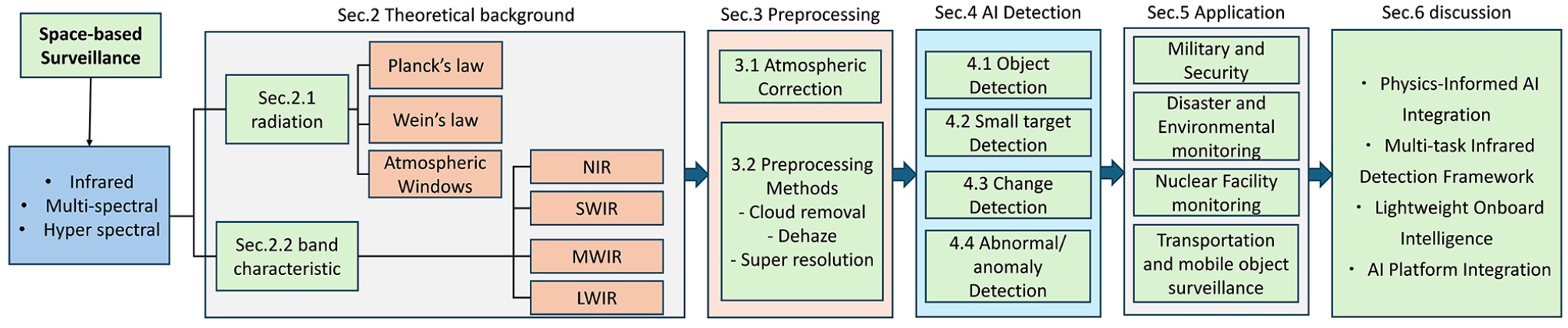
- As national security threats diversify and the demand for persistent surveillance grows, infrared (IR) satellite imagery has become increasingly important because it enables day-and-night observation and provides thermal information complementary to visible imagery. The rapid advancement of deep learning has further shifted IR image analysis from conventional methods to data-driven intelligent detection. However, existing surveys are mostly limited to specific tasks, lacking a comprehensive review of the full AI-based IR image analysis pipeline. This paper presents an integrated survey spanning from the physical principles of IR radiation and preprocessing to AI-based detection and applications. Radiative transfer fundamentals and band-dependent sensing characteristics are first reviewed, followed by an examination of how physics-based atmospheric correction and deep learning-based restoration methods jointly enhance image reliability. For detection, we classify technologies into four tasks: object detection, infrared small target detection (IRSTD), change detection, and anomaly detection, and systematically compare key algorithms, benchmark datasets, and performance for each. Through this comprehensive analysis, we identify key open challenges and future directions for advancing satellite-based IR detection toward operational deployment. - COLLAPSE
-
Case Study
- Evolution of AI-based change detection for low-to-medium resolution satellite imagery and design strategies for user-customized generalized platforms
- Heein Yang, Daehee Kim
- With the rapid advancement of Earth observation satellite technology and the widespread operation of small satellite constellations, optical image data capable of …
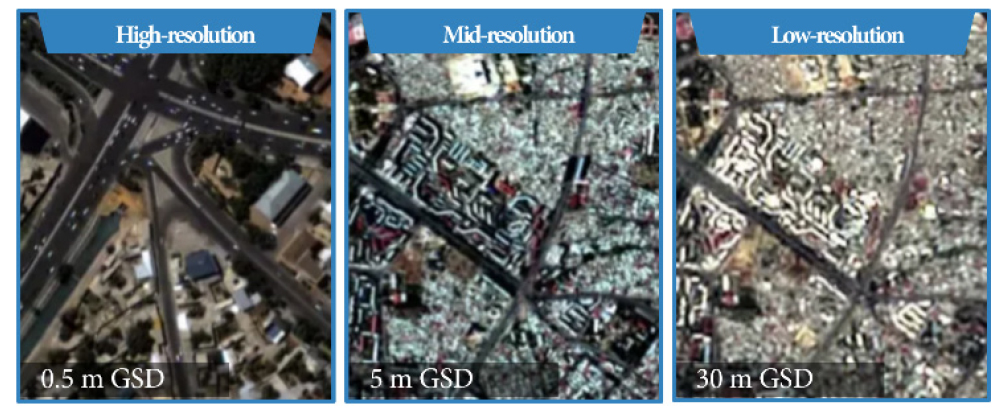
- With the rapid advancement of Earth observation satellite technology and the widespread operation of small satellite constellations, optical image data capable of monitoring wide areas on a regular and continuous basis is exploding. The accumulation of this time-series data has highlighted the importance of change detection technology, which identifies and interprets changes in the Earth’s surface in a rapidly changing global environment driven by climate change, large-scale natural disasters, urbanization, and international conflict. Change detection based on low- to mid-resolution optical satellite imagery offers significant value for wide-area and long-term monitoring. However, it presents technical challenges that differ from high-resolution change detection, which focuses on detecting the presence and changes of targets, due to differences in pixel characteristics across time periods, location alignment errors, and radiometric mismatches caused by the atmosphere, clouds, and seasonality. This paper assesses the current state of change detection technology based on low- to mid-resolution satellite imagery and provides an in-depth analysis of the evolution of deep learning architectures. This study quantitatively and qualitatively examines how the evolution of deep learning models has contributed to improved change detection performance, starting with traditional statistical techniques, moving on to Convolutional Neural Networks (CNNs), UNet-based Siamese networks, and the Vision Transformer (ViT), which captures global context. Finally, we present the State Space Model (SSM)-based Mamba architecture, which has recently become a leader in change detection, demonstrating superior spatial feature capture while maintaining linear computational complexity. However, despite the advancements in deep learning model architecture, a new model-centric approach alone cannot fully satisfy the complex and diverse requirements of real-world applications. This study emphasizes that while improving the performance of the AI model itself is crucial, designing a monitoring system tailored to the end user’s needs (analysis objectives, target objects, and resolution) is a critical factor in determining practical success or failure. Furthermore, the paper concludes by suggesting the necessity of building a ‘next-generation generalized change detection platform’ that will accommodate various foundation models and heterogeneous sensor data (hyperspectral, SAR, etc.) and provide general-purpose functions by integrating intelligent preprocessing such as cloud and haze removal, and its specific development direction. - COLLAPSE
-
Research Article
- A foundaional study on the development of space security professionals
- Jungsik Um, Taehawn Cho, Mika Lim
- This study proposes a framework for developing a space security education program for the Korea Society of Space Security (KSSS). Reflecting the …
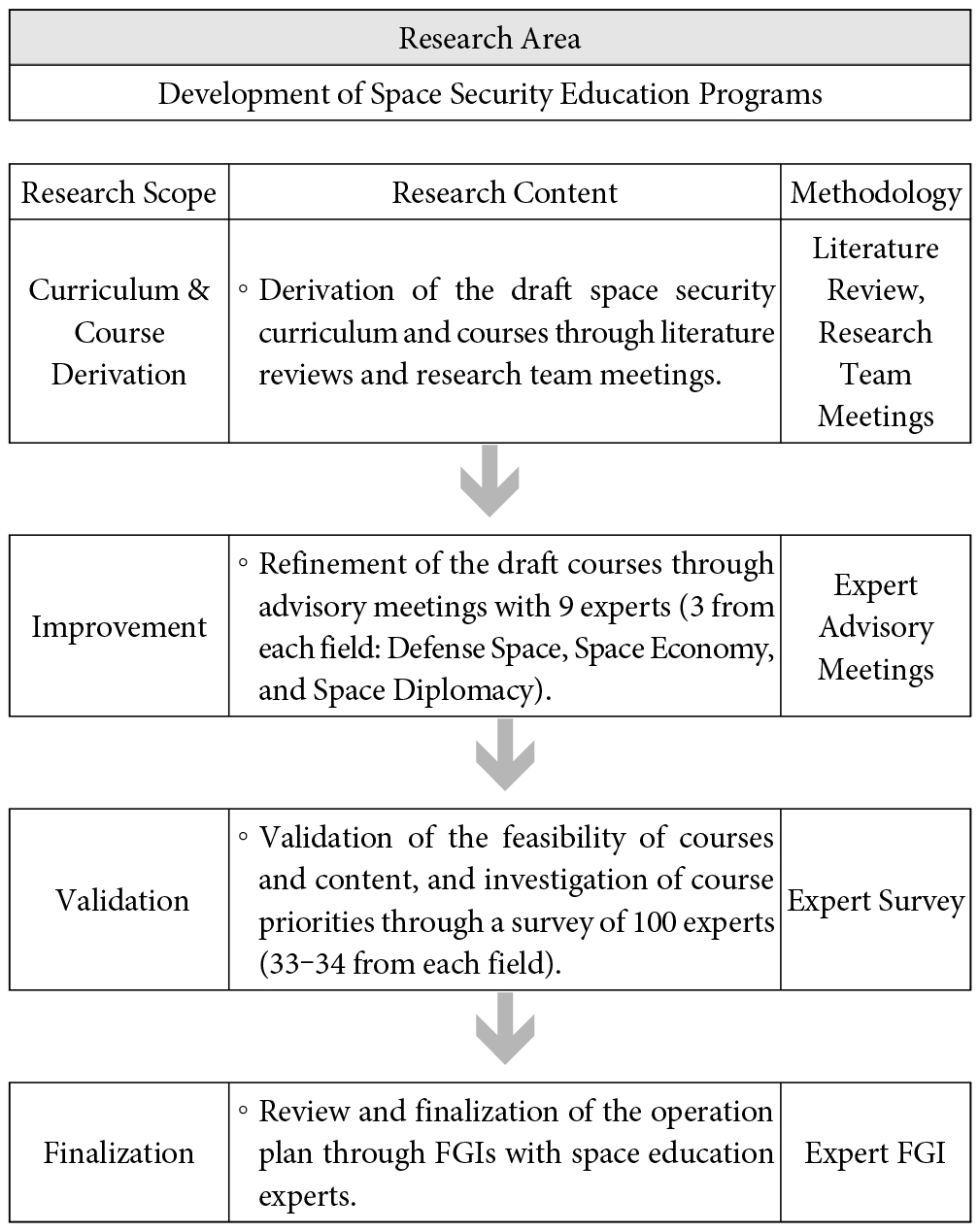
- This study proposes a framework for developing a space security education program for the Korea Society of Space Security (KSSS). Reflecting the policy importance of space security in Korea’s Fourth Master Plan for Promotion of Space Development and the institutional expansion of defense and intelligence-related space functions, the study designs an integrated curriculum that links defense space, the space economy, and space diplomacy. The research uses a sequential design consisting of literature review, comparative case analysis, expert advisory meetings, a survey of 100 experts, and FGIs with nine experts. The revised manuscript specifies the sampling logic, survey variables, analysis procedure, and case-selection criteria, and it adds a reporting framework for expert-priority data and a detailed curriculum matrix. The proposed model adopts KAIST’s project-based, apprenticeship-style training and the U.S. Space Force/NSSI model of tiered and joint/coalition-oriented education. The program is structured as a dual-track system consisting of general and professional courses, with the aim of strengthening Korea’s practical capacity for space security policy, operations, industry, and international cooperation. - COLLAPSE
-
Research Article
- A study on data mining and fault prediction using long-term satellite telemetry
- Dong-Hwan Yoon, Jiseung Ahn, Jingi Ju, Mincheol Shin, Jeongyeol Choe
- As the number of operational satellites increases rapidly in the New Space era, there is a critical need for automated intelligent monitoring …
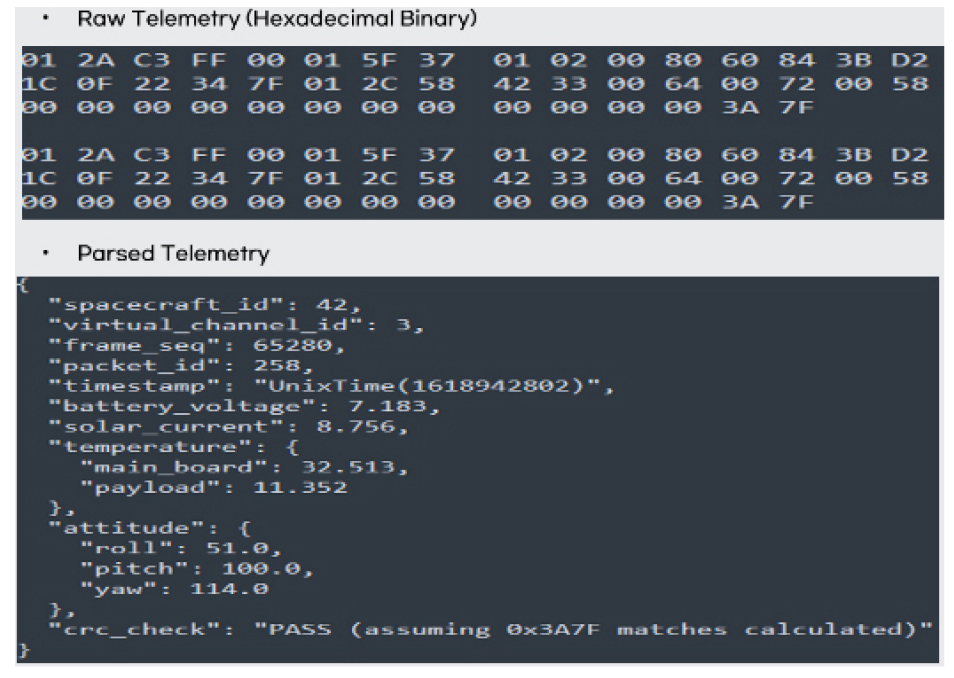
- As the number of operational satellites increases rapidly in the New Space era, there is a critical need for automated intelligent monitoring to manage multiple spacecraft with limited personnel. This paper presents a practical data-driven approach for anomaly detection and fault prediction based on long-term telemetry from the KOMPSAT-2 satellite. We developed a preprocessing pipeline to organize 16 years of telemetry (2006-2022), totaling 158 GB and approximately 2,900 channels, into a structured, analysis-ready dataset while addressing issues such as irregular sampling and missing values. In collaboration with domain experts, we reviewed 300 historical anomaly reports to identify and label key fault events. Considering the scarcity of labeled data in real-world operations, we evaluated several unsupervised techniques, including autoencoders and Isolation Forest, to identify off-nominal behaviors. Our findings show that the proposed approach successfully captured both known fault signatures and undocumented deviations, such as subtle signals from orbit maneuvers. These results demonstrate the potential of AI-based telemetry mining to provide early warnings and support satellite operations. This work establishes a foundational framework for intelligent fault detection systems, which will be essential for the efficient management of large satellite constellations in the future. - COLLAPSE
-
Research Article

- The peaceful use of outer space with domestic law on the space security law
- Jong Hyun Hong
- This article examines the evolving legal and strategic landscape of global space security, with a primary focus on establishing a robust framework …
- This article examines the evolving legal and strategic landscape of global space security, with a primary focus on establishing a robust framework for South Korea. It differentiates between utilizing space for terrestrial defense and securing space assets themselves against threats like anti-satellite weapons, cyber-attacks, and orbital debris. Outer space has evolved from a domain of superpower rivalry into a densely populated strategic environment encompassing state, commercial, and military actors. Existing international legal frameworks — most notably the Outer Space Treaty of 1967 — were conceived in a bipolar world and are manifestly insufficient to address the security challenges of the twenty-first century. This article argues that the necessities of space security law are both urgent and multidimensional, spanning arms control, attribution, critical infrastructure protection, debris governance, equitable access, and the accountability gap created by the rapid commercialisation of space activities. Drawing on international relations theory, treaty law, and emerging state practice, the article identifies seven foundational pillars that any credible space security legal order must address. It further contends that the failure to develop binding norms risks irreversible environmental degradation of orbital space, miscalculation between major powers, and the effective monopolisation of a global commons by a small number of technologically advanced states. The legislative approaches of major powers, highlighting the United States’ military institutionalization through its Space Force and the European Union’s emphasis on sustainability and safety regulations are analyzed. Central to the discussion is the application of international humanitarian law, specifically regarding the “dual-use” nature of satellites and the principles of proportionality and distinction during conflicts. Ultimately, the research emphasizes the necessity for South Korea to modernize its domestic space laws to balance industrial innovation with national security requirements. The evolution of space law has reached a turning point, shifting from the research-centric focus of the Cold War to a security and economy-centric framework for the 21st century. For students of international law, three takeaways are paramount: 1) The Policy Shift: Governance is moving from R&D promotion toward complex traffic management and the regulation of the space economy. 2) The Necessity of Resilience: Legal frameworks must incentivize the ability of space systems to recover functions quickly after damage, moving beyond simple defense to “survivability.” 3) Domestic Implementation: International treaties require domestic teeth. We see this in Korea’s 4th Basic Plan for Space Development Promotion, which underscores the need for a domestic Space Security Act to fulfill treaty obligations and protect national assets. Ultimately, we must defend the vision of outer space as the “Common Heritage of Mankind.” It is our shared duty to ensure this domain remains a sanctuary for peaceful cooperation rather than a theater for conflict. - COLLAPSE
-
Research Article
- Security assessment of Internet-exposed satellite ground segments via non-intrusive reconnaissance
- Hyeongjun Choi, Young Eun Kwon, Ji Won Yoon
- The rapid transition of satellite communication networks toward IP-centric architectures has expanded the remotely reachable attack surface of the ground segment. While …
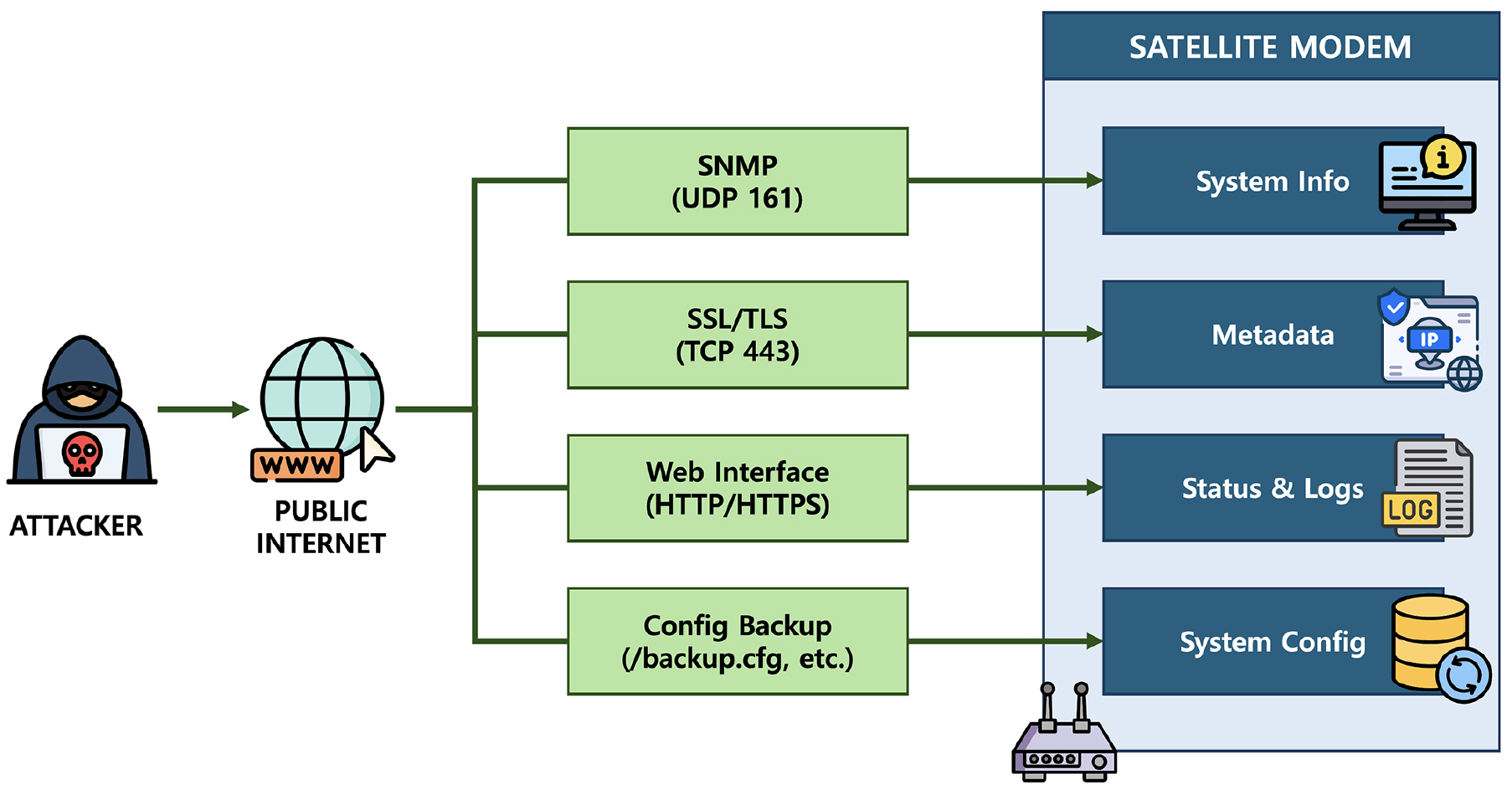
- The rapid transition of satellite communication networks toward IP-centric architectures has expanded the remotely reachable attack surface of the ground segment. While prior security research has predominantly emphasized physical and link-layer threats, security weaknesses in the logical management plane remain insufficiently characterized at Internet scale. This paper presents a comprehensive, non-intrusive security assessment of Internet-exposed satellite modems using Open Source Intelligence and lightweight verification. We propose four assessment modules targeting legacy management protocols such as SNMP, SSL/TLS certificate metadata, web-based management interfaces, and configuration backup mechanisms. Our evaluation indicates that exposure through legacy management services is often constrained by access controls, whereas user-facing web interfaces and configuration workflows continue to exhibit recurring weaknesses. We show that SSL/TLS certificate metadata observable through Internet measurements can leak organizational and deployment context that supports precision reconnaissance. We also identify patterns of unauthenticated diagnostic access and predictable configuration artifact endpoints that may disclose sensitive operational information and reduce the barrier for follow-on compromise when combined with weak authentication or misconfigured access control. Overall, the results suggest that the dominant risk to satellite ground segments is increasingly driven by application-layer misconfigurations and operational workflow weaknesses rather than simple network-level port exposure, underscoring the need to adopt Secure by Design principles for remote management and configuration lifecycle controls. - COLLAPSE

 JOURNAL OF SPACE SECURITY





 Korean Academy of Space Security
한국우주안보학회
#909 Instopia,120, Eonju-ro, Gangnam-gu, Seoul, Republic of Korea
Tel: 82-2-2039-1670 / E-mail: kass@kass.ne.kr Copyright© Korean Academy of Space Security. Powered by APUB
Tel: 82-2-2039-1670 / E-mail: kass@kass.ne.kr Copyright© Korean Academy of Space Security. Powered by APUB