


1. INTRODUCTION
2. BACKGROUND
2.1. Satellite Ground Segment and IP Transition
2.2. Management Plane Protocols
2.3. Internet wide Scanning and OSINT
3. OVERVIEW
3.1. Motivation
3.2. Threat Model
4. METHODOLOGY
4.1. Automated SNMP Reconnaissance and Metadata Extraction
4.2. Acquisition of SSL/TLS Certificate Metadata via OSINT
4.3. Web Interface Accessibility Assessment
4.4. Automated Scanning for Configuration Backup Exposure
5. EVALUATION
5.1. Experimental Overview
5.2. Quantitative Analysis of Attack Surface
5.3. Vulnerability Verification Case Studies
6. DISCUSSION
6.1. Attack Surface Shift: From Legacy to Web
6.2. The Paradox of SSL Metadata
6.3. Critical Impact of Configuration Artifacts
6.4. Limitations and Ethical Considerations
7. CONCLUSION
1. INTRODUCTION
Satellite communication has established itself as a cornerstone of global telecommunications infrastructure [1]. The rapid deployment of Low Earth Orbit (LEO) mega constellations has revolutionized this domain by providing high-speed broadband internet access to previously unconnected regions. The strategic importance of such resilience was notably demonstrated during the war in Ukraine, where satellite links maintained vital communications when terrestrial networks failed [2]. These advancements complement traditional mission-critical services such as maritime tracking and aviation monitoring [3]. Central to these operations is the satellite modem. This device performs the essential function of modulating and demodulating signals to enable data exchange between user terminals and the satellite network. Historically, such equipment operated within closed and isolated environments. However, the increasing demand for remote management and real-time telemetry has driven a paradigm shift toward IP-based connectivity [4].
Despite this expanded connectivity, security research in the satellite domain has disproportionately focused on the physical and link layers. Extensive studies have documented threats such as signal jamming, spoofing, and eavesdropping on the air interface [5,6]. While these attacks are theoretically severe, they impose a high barrier to entry, as adversaries typically require specialized Software-Defined Radio (SDR) hardware, physical proximity to the target, and deep knowledge of proprietary waveforms [7]. This perspective overlooks a more immediate and scalable threat posed by the management plane. We argue that for a motivated adversary, exploiting a misconfigured web interface or a weak administrative credential is significantly more cost-effective and stealthy than jamming a signal. A key risk lies not only in sophisticated signal manipulation but also in commonplace management-plane weaknesses that can enable unauthorized access or sensitive information disclosure over the public Internet [8].
The implications of these management-plane weaknesses extend beyond conventional IT security. Satellite ground segments are increasingly recognized as critical national infrastructure, and recent policy initiatives reflect this recognition. In the United States, the Cybersecurity and Infrastructure Security Agency has convened the Space Systems Critical Infrastructure Working Group, which identifies space systems as a foundational dependency for the communications, defense, energy, and transportation sectors and has issued operator-facing recommendations aligned with the NIST Cybersecurity Framework. The U.S. Space Policy Directive-5 on Cybersecurity Principles for Space Systems formally establishes Secure by Design as a baseline expectation for the space sector. At the international level, the ISO/TS 20517 technical specification codifies analogous requirements for cybersecurity management across space products, services, and ground equipment. Recent ground-segment compromises have shown that weaknesses originating at the management plane can cascade outward to disrupt civilian users at continental scale and to degrade allied military communications during active conflict. Empirical characterizations of the gap between these policy expectations and the deployed reality of commercial ground terminals, however, remain scarce. Establishing such empirical evidence is therefore not merely a network-security exercise but a precondition for informed space security policy.
Prior work on Internet-exposed satellite devices has largely been limited to high-level enumeration. Studies utilizing search engines like Shodan have successfully quantified the number of exposed devices [9], yet they often stop at discovery without assessing the depth of compromise feasible through these exposures. Conversely, firmware-level analyses have identified specific vulnerabilities in isolated devices but lack a systemic view of how these flaws manifest in active, large-scale deployments [10]. There remains a critical gap in understanding how remote actors can chain seemingly minor misconfigurations, such as exposed status pages or backup utilities, to compromise the confidentiality and integrity of these systems without ever touching the radio frequency spectrum.
In this paper, we address this gap by presenting a comprehensive security analysis of Internet-exposed satellite modems, focusing exclusively on the management and control planes. We construct a taxonomy of Remote Service Adversaries and evaluate realistic attack scenarios ranging from passive reconnaissance to potential system compromise. Our contributions are as follows:
•Large-Scale Exposure Analysis. We utilize OSINT techniques to map the global attack surface, identifying the operational risks associated with legacy protocols like Simple Network Management Protocol (SNMP) while revealing how SSL certificate metadata inadvertently leaks sensitive operational context about critical infrastructure.
•Threat Modeling of Configuration Management. We identify and analyze critical attack vectors within administrative workflows. Specifically, we examine how insecure configuration backup mechanisms serve as high-value targets for adversaries to bypass authentication and gain persistent access.
•Empirical Assessment of Access Controls. We provide empirical data on the prevalence of unsecured administrative interfaces, providing empirical evidence that some Internet-exposed terminals disclose diagnostic and status information without adequate access control.
2. BACKGROUND
2.1. Satellite Ground Segment and IP Transition
Modern satellite communication networks comprise three primary segments consisting of the space segment, the control segment, and the user segment [11]. The satellite modem serves as the critical interface in the user segment and is responsible for modulating baseband data onto radio frequency carriers. Historically, these terminals were designed as bent pipe relays with limited processing capabilities. They were often connected to local hosts via serial interfaces such as RS-232 within closed and proprietary networks. However, the paradigm has shifted toward IP centric architectures [4]. Contemporary Very Small Aperture Terminal systems and satellite gateways are now deployed with full TCP/IP stacks and embedded operating systems including Linux based firmware to support high throughput applications and remote telemetry. This evolution allows operators to manage devices remotely over the public Internet but inadvertently exposes these specialized systems to general purpose network attacks [6].
2.2. Management Plane Protocols
The management plane facilitates the configuration, monitoring, and troubleshooting of satellite terminals. Two primary protocols are ubiquitous in this domain. The first is web based administration where most modern terminals host a web server to provide a graphical user interface for configuration. These interfaces allow administrators to modify uplink frequencies, view signal to noise ratios, and manage user accounts. While convenient, they often suffer from weak default configurations or lack rigorous access controls [8]. The second is the Simple Network Management Protocol which is widely used for aggregated monitoring of network devices. This protocol exposes a hierarchical database of variables known as Management Information Bases including device descriptions, uptime, and traffic statistics. In satellite deployments, this protocol is essential for Network Operations Centers to monitor link health yet it is frequently deployed with default community strings such as public which leads to unauthorized information disclosure [12].
2.3. Internet wide Scanning and OSINT
Internet-wide scanning has become a standard methodology for assessing the security posture of distributed infrastructure [9]. Tools such as Shodan and Censys continuously crawl the IPv4 address space to index service banners, port states, and metadata without performing intrusive exploitation. The first technique is banner grabbing where scanners establish a connection handshake and record the initial response banner from services like Hypertext Transfer Protocol (HTTP), FTP, or Telnet. These banners often contain specific product names or firmware versions that fingerprint the device as a satellite modem. The second technique involves the analysis of metadata within X.509 certificates for encrypted services. The metadata fields within these certificates such as the Common Name or Organization field can reveal the identity of the operator or the geographic location of the terminal [13]. This data provides high fidelity targets for reconnaissance.
3. OVERVIEW
3.1. Motivation
The convergence of satellite technology with standard internet protocols has fundamentally altered the operational landscape of ground segments. Administrators increasingly prioritize operational convenience and remote accessibility over strict isolation principles. This shift allows personnel to troubleshoot connectivity issues or update firmware from central offices without dispatching engineers to remote field sites such as maritime vessels or oil rigs. However, this operational efficiency creates a dangerous trade off. The reliance on commercial off the shelf hardware and standard management protocols often leads to the inheritance of legacy vulnerabilities found in general IT equipment. A recent experimental analysis on satellite firmware revealed that many embedded devices suffer from memory corruption vulnerabilities and hardcoded credentials which serves as a stark reminder that obscurity is not security [14]. Furthermore, the lack of secure by design principles in the user segment has been identified as a critical gap in complying with emerging standards like the IRIS2 infrastructure [15]. This disconnect between the capabilities of modern hardware and the security practices of operators serves as the primary motivation for this paper.
3.2. Threat Model
In this subsection, we formalize the operational environment and the adversarial framework used to evaluate the security of satellite modems. We derive our model from real world deployment observations to ensure practical relevance.
3.2.1. System Model and Scope
The system model considers a commercially available satellite terminal that functions as a bidirectional gateway between a local network and a satellite constellation. These devices are frequently deployed in remote locations such as maritime vessels or industrial sites where physical security is robust but network security is often overlooked. We specifically focus on terminals that expose their management interfaces to the public Wide Area Network due to misconfigured port forwarding or the lack of a firewall. Empirical measurements on maritime VSAT networks have demonstrated that attackers can easily fingerprint these exposed terminals and correlate them with specific vessels using open source intelligence [16]. The scope of this analysis is strictly limited to the logical management plane reachable via standard Internet protocols. We exclude physical attacks on the hardware or direct jamming of the radio frequency link from this specific model to emphasize the risks inherent in network connectivity alone.
3.2.2. Asset Identification
A formal security analysis requires the explicit identification of the assets that require protection within the satellite terminal ecosystem. We identify three critical asset classes that are susceptible to network based exploitation. The first asset is Authentication Data which includes administrator passwords, SNMP community strings, and API keys. Compromise of these credentials grants an attacker full control over the terminal. The second asset is Configuration Integrity which encompasses startup configuration files, firewall rules, and routing tables. Unauthorized modification of these files can lead to persistent backdoors or traffic redirection. The third asset is Operational Continuity. As evidenced by the cyberattack against KA-SAT modems during the conflict in Eastern Europe, the integrity of the firmware and bootloader is paramount. Attacks targeting these components can induce permanent denial of service conditions that require physical hardware replacement [2].
3.2.3. Adversary Capabilities
We define a specific class of threat actor termed the Remote Service Adversary to characterize the threats facing Internet exposed terminals. This adversary possesses no physical access to the device and lacks the specialized hardware required for radio frequency manipulation. Their capabilities are limited to standard network interactions using off the shelf software and public search engines. This actor models an opportunistic attacker or a botnet operator seeking to compromise vulnerable edge devices at scale rather than a targeted state sponsor with unlimited resources. The adversary utilizes passive reconnaissance to identify targets through banner analysis and certificate inspection. Following identification, they attempt to leverage logical misconfigurations or default credentials to gain unauthorized access to the system control panel. This model aligns with the capability sets observed in recent firmware emulation studies where automated tools were sufficient to trigger critical faults [10].
3.2.4. Attack Surfaces
The primary attack surface consists of the administrative services exposed by the terminal firmware. The first vector is the web management interface which typically listens on standard ports and handles sensitive configuration parameters. An adversary targets this interface to bypass weak authentication mechanisms or to extract system logs. The second vector involves the configuration backup mechanism where downloadable files may contain unencrypted credentials or internal network maps. The third vector includes legacy monitoring protocols like SNMP which often remain active by default and leak system information to unauthenticated requestors. We assume that successful exploitation of these surfaces allows the adversary to compromise the confidentiality and integrity of the satellite communication link without requiring a software defined radio.
4. METHODOLOGY
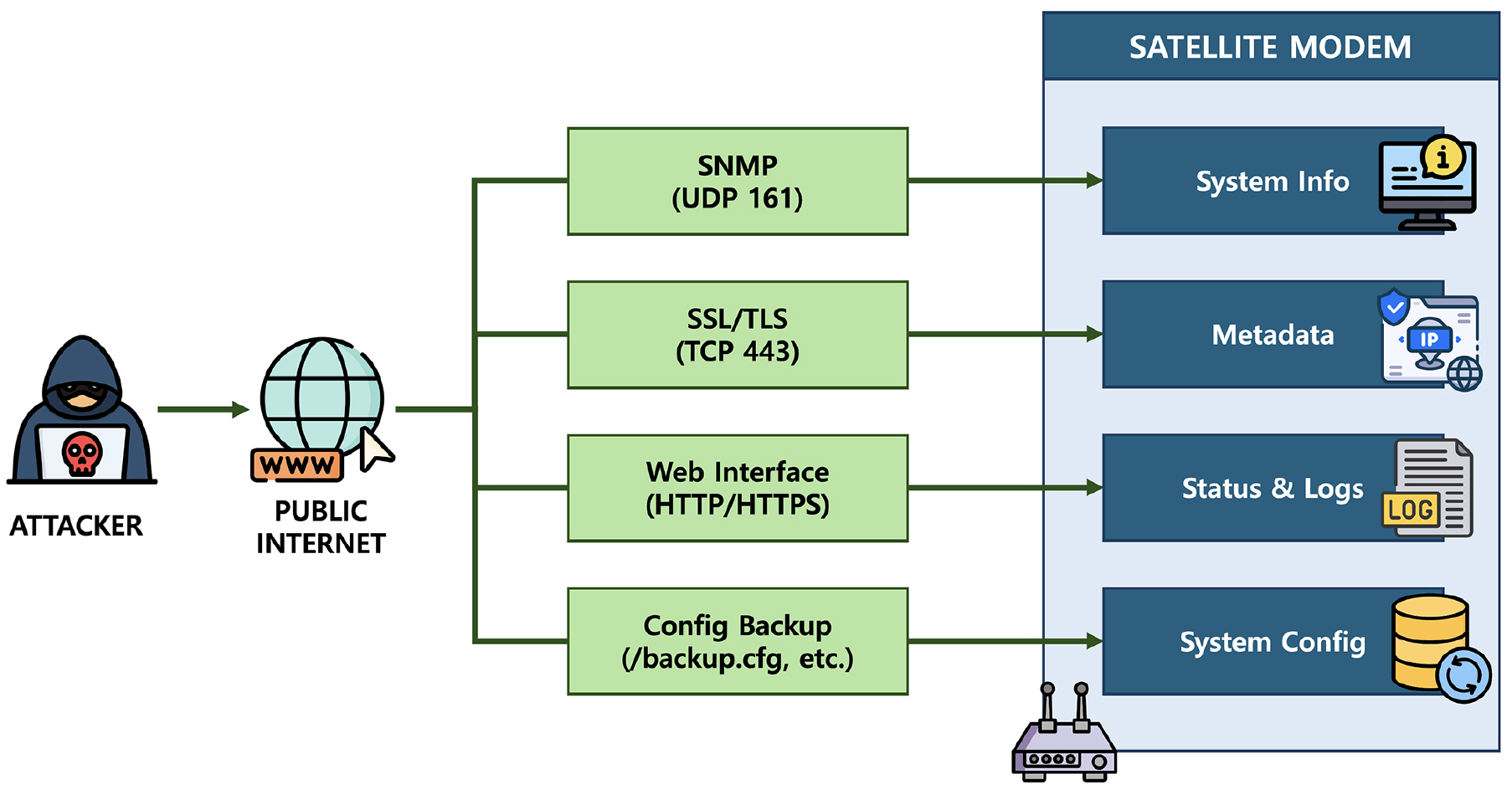
This section delineates the experimental framework and technical implementation details employed to assess the security posture of Internet-exposed satellite ground segments. The methodology was designed to strictly adhere to passive reconnaissance principles to ensure that no active exploitation or unauthorized state changes occurred on the target systems. The research framework integrates open source intelligence with custom automated verification tools to map the attack surface across four distinct assessment modules encompassing SNMP exposure, SSL metadata leakage, web management accessibility, and configuration backup vulnerability. Fig. 1 illustrates the overall assessment framework and the four targeted attack vectors, ranging from legacy management protocols to application-layer exposures.
4.1. Automated SNMP Reconnaissance and Metadata Extraction
To investigate the prevalence of information leakage through the SNMP, we developed a specialized reconnaissance module utilizing the Python programming language. This module interfaces directly with the net-snmp command-line utilities and specifically employs the snmpget command to probe target devices. The experimental design was strictly confined to a read-only interaction model. The scanner was hard-coded to utilize the default community string public and the SNMP version 2c, which reflects the most common default configurations found in legacy satellite equipment. Explicit safeguards were implemented within the code to disable any SET operations, which eliminates the risk of accidental modification of the configuration parameters of the target [17].
The reconnaissance process involved a systematic query of the Management Information Base (MIB-II) system group. The script was programmed to retrieve a specific set of Object Identifiers (OIDs), including sysDescr (1.3.6.1.2.1.1.1.0) for system description, sysName (1.3.6.1.2.1.1.5.0) for host identification, and sysContact (1.3.6.1.2.1.1.4.0) for administrative contact information. These variables provide high-fidelity device fingerprinting data without exposing sensitive routing or user information. The raw output returned by the SNMP agent was processed using Python’s subprocess module to capture standard output and strip extraneous formatting, ensuring that the extracted metadata was normalized for subsequent analysis.
To maintain the stability of the target infrastructure, the scanning engine incorporated strict concurrency controls and error handling mechanisms. A specific timeout of 3.0 seconds was enforced for each request to prevent thread exhaustion or network congestion. The tool categorized response failures into distinct classes including network timeouts and connection refusals to facilitate statistical analysis of the filtering policies applied by network operators. All successful responses were parsed and logged into a structured format that captures the IP address and the raw values of the retrieved variables for offline correlation [18].
4.2. Acquisition of SSL/TLS Certificate Metadata via OSINT
To characterize the deployment landscape of satellite ground segments without initiating intrusive network connections, we implemented a passive reconnaissance module leveraging the Shodan Application Programming Interface. This approach allows for the identification of active terminals by analyzing publicly available X.509 certificate information rather than establishing direct Transmission Control Protocol handshakes. The data acquisition process was driven by a Python-based script designed to iterate through a dictionary of search queries targeting specific device fingerprints. Instead of focusing on a single vendor, the target scope encompassed a diverse set of major satellite ecosystem providers to ensure a representative sample of the global infrastructure. The search strategy utilized advanced query operators to filter for certificates containing keywords associated with these manufacturers in either the subject or issuer fields which captures both self-signed certificates and those issued by legitimate certificate authorities.
The extraction pipeline was engineered to retrieve and parse the JSON responses returned by the API. For each positive match, the script isolated the IP address and the port number along with the hierarchical components of the Distinguished Name of the certificate. The extraction process prioritized three primary attributes including the Common Name, the Organization, and the Locality from both the subject and issuer sections. These fields serve as critical identifiers for attributing generic IP addresses to specific industrial sectors such as maritime logistics or energy exploration without requiring active interaction with the device. To manage the volume of data and maintain the integrity of the dataset, the query execution was constrained by a specific limit of fifty results per query category. Exception handling mechanisms were embedded to manage API timeouts and malformed data fields which ensures the continuity of the collection process [9].
Following the acquisition phase, a post-processing algorithm normalized the raw datasets to facilitate statistical analysis. The logic prioritized the Common Name and Organization fields to classify the terminals by industry vertical and operator type. The extracted Locality data was cross-referenced to infer the physical geographic distribution of the ground stations. The final output was serialized into a structured comma-separated Values format which creates a consolidated inventory that links certificate metadata to deployment contexts. This methodology provides a high fidelity mechanism for mapping the organizational structure of satellite networks using exclusively public-facing metadata while strictly preserving the anonymity of specific operators in the final analysis.
4.3. Web Interface Accessibility Assessment
The assessment of web management interfaces was conducted in two distinct phases to identify unauthenticated administrative dashboards without compromising system integrity. The first phase involved the aggregation of candidate hosts using high specificity fingerprinting queries via the Shodan Application Programming Interface. To filter out generic web servers and focus solely on embedded satellite controllers, the search strategy targeted specific HTTP headers and HTML titles known to be unique to satellite modem firmware, such as identifiers for iDirect or Newtec platforms. The resulting list of candidate IP addresses and ports was serialized into a target inventory file, serving as the input for the subsequent active verification stage.
The second phase involved the active verification of these candidates using a custom Python script utilizing the requests library. The script was programmed to send HTTP GET requests to a curated list of common administrative paths derived from vendor documentation, including /admin, /status.asp, /overview, and /cgi-bin/home.cgi. To simulate legitimate user traffic and avoid triggering bot mitigation systems, the scanner utilized a fixed User-Agent string mimicking a standard web browser (Mozilla/5.0). A strict timeout of 5.0 seconds was enforced for each connection attempt to prevent prolonged resource consumption on the target device, ensuring a lightweight footprint.
The vulnerability classification logic relied on a combination of HTTP status codes and content analysis to minimize false positives. A target was classified as accessible only if the server returned a 200 OK status code and the response body contained specific keywords indicative of a valid administrative dashboard, such as modem, status, or overview. This content-based verification was crucial to distinguish genuine dashboards from default server pages or generic error messages. The tool explicitly avoided submitting any login credentials, performing brute-force attacks, or attempting to bypass authentication forms. Instead, it focused solely on identifying pages that were misconfigured to allow anonymous read access to system telemetry and status information [19].
4.4. Automated Scanning for Configuration Backup Exposure
Complementing the web interface analysis, we devised a specialized scanner to verify the exposure of configuration backup files which poses a critical security risk as these archives often contain plaintext credentials and internal network maps. The assessment tool was engineered to process the list of web-enabled satellite terminals generated in the previous stage and systematically check for the presence of sensitive files at predictable resource locations. The search dictionary was constructed based on an analysis of vendor documentation and common firmware defaults targeting specific paths such as /backup.cfg, /settings.conf, /config/settings.xml, and /download/backup.zip.
To optimize performance across a large address space, the scanner was implemented using the concurrent.futures module in Python and employed a ThreadPoolExecutor with a maximum of ten worker threads. This parallel processing architecture allowed for rapid verification while maintaining a controlled request rate to avoid network congestion. The verification logic employed standard HTTP GET requests with a conservative timeout of 3.0 seconds. A sophisticated detection heuristic was implemented to reduce false positives caused by soft 404 responses where a server returns a valid status code for a custom error page.
The scanner defined a successful detection based on two strict criteria including the return of a 200 OK status code and a response body size exceeding a threshold of 50 bytes. This size constraint effectively filtered out empty responses or brief redirect messages that did not contain actual configuration data. For each positive detection, the tool recorded the full URL and the HTTP status code along with the content length in bytes. To adhere to ethical research standards, the scanner was programmed to verify the existence and size of the file only without storing the file contents to disk. Furthermore, the tool did not parse the files for sensitive data such as passwords which provided statistical evidence of vulnerability prevalence without compromising the confidentiality of the target organizations’ data.
5. EVALUATION
This section presents the empirical findings and statistical distribution derived from the proposed methodology and verifies the technical validity of the vulnerabilities identified by each assessment module. By analyzing the results, we provide a quantitative and qualitative assessment of the attack surface.
5.1. Experimental Overview
The primary objective of this evaluation is to assess the security vulnerabilities across the satellite modems and verify the inherent risks associated with identified attack surface. We focus the scope on public address spaces identified through the Shodan search engine, specifically assets belonging to satellite ground stations and user terminals. To ensure the strict ethical compliance, all experiments are conducted according to a rigorous, non-intrusive scanning protocol. Under these methodological constraints, the research is restricted to passive collection.
5.2. Quantitative Analysis of Attack Surface
5.2.1. SNMP Exposure Analysis
The scanning results of the target IP list indicated that no hosts returned valid system metadata when queried using the public community string. This empirical outcome suggests that the majority of operators have implemented fundamental security measures, such as blocking UDP port 161 via network firewalls or reconfiguring default community strings. Consequently, the possibility of initial penetration through the SNMP is relatively low compared to the vulnerabilities identified within web-based attack vectors in current operational environment.
5.2.2. SSL/TLS Certificate Metadata Distribution
The reconnaissance targeting the target infrastructure successfully yielded over 400 valid certificate metadata records across eight major vendors. Analysis of the vendor distribution revealed that Vendor A accounted for the highest share with 42 instances, followed by Vendor B (39), Vendor C (22), and Vendor D (18).
Furthermore, the investigation of organizational and geographic attribution provided critical insights into the deployment environments of the ground segments. By analyzing fields related to the Organization in certificates, we found that some records contain strings resembling organization names that could aid attribution or targeting. Because certificate fields are supplied by operators and may be outdated or not specific, we treat these indicators as contextual hints rather than ground truth operator identity. Locality fields, when present and meaningful, can provide coarse location hints. However, their accuracy depends on operator input practices. Thus, we interpret location inference as indicative rather than definitive.
5.3. Vulnerability Verification Case Studies
5.3.1. Web Management Interface & Information Leakage
In this assessment, we identified 19 candidate hosts through the Shodan API. We utilized custom automated inspection scripts to probe critical administrative paths including /admin, /status, and /overview. The automated results indicated that the majority of devices returned HTTP 403 or 401 responses, indicating that direct authentication bypasses were not feasible through automated scanning alone.
However, manual analysis, particularly regarding Vendor E devices, revealed that several status pages remained accessible without any authentication. These pages, specifically the Event Log page, leaked plaintext data including alarm history, reboot timestamps, and detailed firmware specifications. The leakage of internal network attributes, such as private IP addresses and MAC addresses, exposes the topology of the internal infrastructure. While this exposure does not grant immediate administrative privileges, it serves as a critical reconnaissance vector that an adversary could utilize for lateral movement within the compromised network.
5.3.2. Configuration Backup Exposure & False Positive Analysis
To evaluate the risks associated with configuration management, we analyzed 165 candidates identified as exposing web interfaces. Our automated verification tool successfully detected 55 URLs that returned an HTTP 200 OK response when attempting to access predictable backup paths, such as /config/settings.xml and /backup.cfg.
To ensure the accuracy of these findings, we implemented a filtering logic based on response file size to distinguish actual vulnerabilities from false positives. We determined that responses approximately 726 bytes in size were largely false positives consisting of custom error pages or login redirects. In contrast, responses ranging from 30 KB to 80 KB, such as the observed cases of 38,767 bytes and 83,730 bytes, were classified as highly probable configuration backups based on our size heuristics. The threat posed by such exposure is severe, as these files often store administrator credentials and firewall rules in plaintext or easily decodable formats. This enables a remote adversary to gain persistent control over the modem and potentially compromise the entire satellite communication link without authentication.
6. DISCUSSION
This section synthesizes the experimental findings to assess the current state of satellite ground segment security. We evaluate the operational risks associated with the identified vulnerabilities and conclude with a discussion on the limitations and the ethical constraints inherent in our methodology.
6.1. Attack Surface Shift: From Legacy to Web
The results from the SNMP assessment module demonstrate that the satellite ground segment has hardened its defenses against legacy management protocols. Most identified devices effectively blocked UDP port 161 through firewalls and Access Control Lists (ACLs) or replaced default community strings, such as public, with more secure alternatives. This indicates that operators have widely adopted security best practices for traditional network services.
However, the web management interface and configuration backup assessments revealed significant vulnerabilities within web-based administrative interfaces. The transition toward IP-centric management has prioritized operational convenience at the expense of security. Consequently, the primary attack vector for satellite terminals has shifted from legacy protocol exploitation to application-layer vulnerabilities, specifically involving misconfigurations and the inadvertent exposure of status pages and backup files.
6.2. The Paradox of SSL Metadata
The analysis of SSL/TLS certificate metadata highlights a notable security side effect: while SSL/TLS protocols are deployed to ensure confidentiality through encryption, they inadvertently facilitate passive reconnaissance. By extracting metadata from over 400 certificates, we demonstrated that unencrypted X.509 fields exposed during the handshake process allow adversaries to identify specific targets.
The inclusion of specific organization names and localities represents a weakness in Operational Security (OPSEC). This exposure enables potential adversaries to fingerprint operating entities without the need for broad scanning, thereby streamlining the initial reconnaissance phase.
6.3. Critical Impact of Configuration Artifacts
The identification of 55 configuration backup files through the configuration backup assessment represents a critical threat to both the integrity and the confidentiality of the satellite ground segment. These artifacts may contain sensitive configuration elements, which could increase the risk of follow-on compromise. The exact sensitivity depends on vendor implementation and cannot be confirmed without content validation.
Furthermore, the exposure of internal network metadata, such as private IP addresses and MAC addresses, provides the essential intelligence for lateral movement. These findings indicate that a compromised satellite terminal can serve as a strategic pivot point, enabling an adversary to extend their reach from the network edge into the operational network, effectively bypassing traditional defenses.
6.4. Limitations and Ethical Considerations
To maintain strict ethical and legal compliance, we adhered to a non-intrusive methodology. Consequently, we did not perform active exploitation, such as attempting administrative logins. While this approach ensures the stability of operational systems, it means we demonstrate the presence of high-risk vulnerabilities, rather than providing definitive confirmation of successful exploitation. Furthermore, there remains a potential for false positives, as we identified the backup files based on HTTP status codes and response body sizes rather than file header verification.
A further consideration concerns vendor identification. Throughout this paper we refer to specific manufacturers using pseudonyms (Vendor A, Vendor B, and so on) rather than commercial names, and we deliberately omit identifying details that would allow individual deployments to be located from the contents of this paper alone. This choice reflects standard practice in security research that examines deployed systems through non-intrusive observation. Two considerations motivate the decision. The first concerns the population under study. The findings reported in this paper describe weaknesses in live, Internet-exposed terminals that remain in active operation, and naming the manufacturers of these terminals would meaningfully lower the barrier for opportunistic targeting of currently deployed and unpatched systems by third parties who have read this paper. The second concerns the nature of the evidence. Because our methodology is strictly non-intrusive and does not include vendor notification or coordinated remediation as part of the study design, attribution of specific weaknesses to specific commercial products in the open literature would create an asymmetric situation in which the research community and potential adversaries gain identifying information simultaneously while operators have no corresponding remediation window. We regard the resulting reduction in reproducibility as an acceptable cost relative to the operational risk that full attribution would impose on real-world operators.
Finally, our scope was restricted to major vendors and standard ports, which means that devices utilizing non-standard ports or less common manufacturers may not be covered in our statistical analysis. Future work should incorporate magic number validation to eliminate false positives in file identification.
7. CONCLUSION
This paper comprehensively assessed the security posture of Internet exposed satellite ground segments using OSINT and nonintrusive reconnaissance techniques. While legacy management protocols such as SNMP showed limited responsiveness under default read only queries, recurring weaknesses were observed in web based management interfaces and configuration workflows. Specifically, the analysis of SSL TLS certificate metadata collected from Internet facing terminals showed that unencrypted X.509 fields visible during the handshake can reveal organization and deployment context that supports precision reconnaissance. Furthermore, the detection of accessible configuration backup resources at predictable paths indicates a potential risk of compromise when sensitive configuration artifacts are exposed, even though this study did not download or parse file contents. Although direct authentication bypass was not feasible through automated scanning alone, manual verification confirmed that some status pages disclosed diagnostic data and internal network attributes, demonstrating that reliance on obscurity is insufficient for protecting management plane interfaces. Overall, these findings suggest that the dominant risk to satellite ground segments increasingly arises from application layer misconfigurations and operational workflow weaknesses rather than simple network level service exposure, underscoring the need for manufacturers and operators to adopt Secure by Design principles for remote management and configuration lifecycle controls.
These findings extend beyond conventional network security and bear directly on space security governance. The application-layer weaknesses observed are precisely the deployment-level failure mode that Secure by Design frameworks for the space sector are intended to prevent, and the gap between policy expectation and operational practice remains substantial. Closing this gap will require coordinated action across manufacturers, operators, and the relevant standardization bodies, with particular attention to configuration artifact lifecycle controls, default-deny segmentation of the management plane, and the reduction of identifying metadata in publicly observable certificates.