


1. INTRODUCTION
2. METHODOLOGY
3. DEVELOPMENT OF THE SPACE SECURITY EDUCATION PROGRAM
3.1. Derivation of Curriculum and Course Modules
3.2. Exemplary Educational Cases
3.3. Space Security Education Program (Draft)
4. CONCLUSION
1. INTRODUCTION
The purpose of this study is to present a plan for developing an educational program for nurturing space security professionals, organized by the Korean Society for Space Security (KSSS). Education for professionals engaged in space security must evolve into customized programs tailored to specific duties and levels. Furthermore, the target audience for space security education needs to be expanded. As space development accelerates, its impact on the safety and efficiency of daily life, the national economy, and national prestige is growing. It is essential to ensure that the public holds a proper awareness of space security and supports space development [1,2].
Since 2022, South Korea has been establishing a space security system centered on defense and intelligence agencies. The Ministry of National Defense drafted its first defense space strategy as a top-level document for military space power development, and the National Intelligence Service-related Regulations on Space Security Affairs specify the collection, production, distribution, and protection of security-related space information [3,4].
The Defense Acquisition Program Administration, the armed services, research institutes, universities, and space companies are increasingly connected through the dual-use character of space technology. This creates a need for common space-security literacy across government, military, industry, and academia. Space security education must therefore integrate defense-space operations, space-industry development, legal and diplomatic governance, and technical awareness of satellite systems and cyber-physical vulnerabilities.
To this end, this study investigates domestic and international space education programs, identifies exemplary cases, and derives implications applicable to an integrated Korean space-security education program. The core contribution of the revised manuscript is to clarify the methodological path from curriculum derivation to expert validation, and to show how KAIST and U.S. Space Force/NSSI cases are reflected in the proposed Korean model rather than cited only descriptively [5].
2. METHODOLOGY
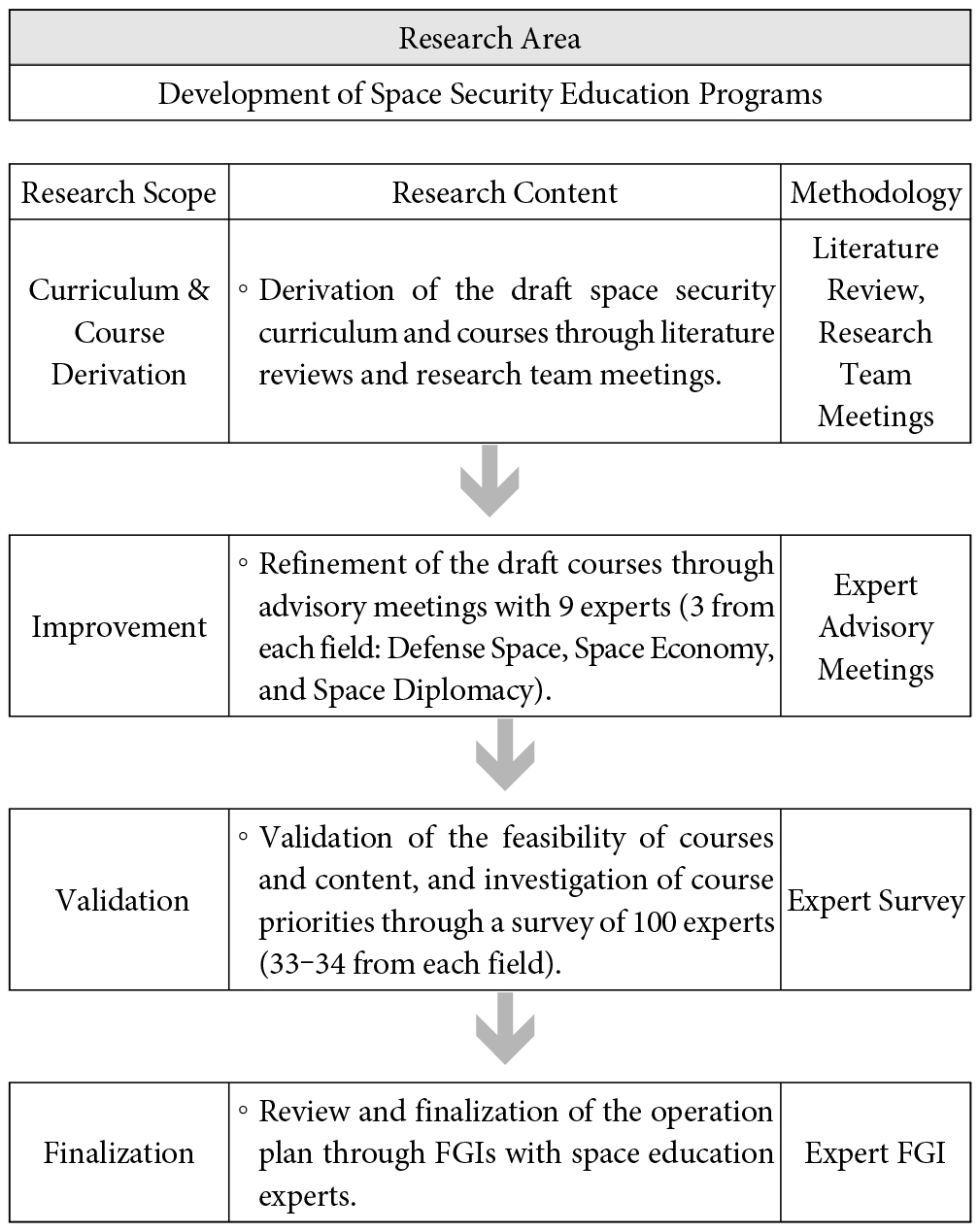
This study employed a sequential mixed-method design consisting of five steps: literature review, comparative case analysis, expert advisory meetings, an expert survey, and focus group interviews (FGIs). The literature review generated an initial pool of domains, subjects, and detailed topics. The case analysis benchmarked domestic and international education programs that combined space technology, security policy, and operational training. Advisory meetings refined the preliminary curriculum, the survey validated the relative feasibility and priority of proposed subjects, and the FGI stage interpreted the survey results and finalized the program architecture.
Expert survey participants were selected through purposive and quota sampling to secure balanced representation across the three pillars of the proposed curriculum. The survey panel consisted of 100 experts: 34 in defense space, 33 in the space economy, and 33 in space diplomacy. Eligibility criteria included professional experience in space policy, national defense, space systems, satellite operations, space industry, law, diplomacy, or university-level space education. The FGI panel consisted of nine experts, three from each domain, so that the three pillars could be reviewed under a common analytical frame.
The survey instrument was constructed from the candidate curriculum generated during the literature review and advisory-meeting stage. Respondents assessed each proposed subject using a five-point Likert scale for necessity, field applicability, policy relevance, and urgency. They also provided priority rankings and open-ended comments. Quantitative analysis should report the mean, standard deviation, relative importance index (RII), and rank order by domain and by subject cluster. Qualitative FGI data should be coded into four categories: curriculum structure, course sequencing, practical training requirements, and implementation constraints (Fig. 1).
KAIST and the U.S. Space Force/NSSI were selected as exemplary cases using five criteria: relevance to space security education, maturity of curriculum architecture, degree of practical training infrastructure, linkage to national policy or operational organizations, and transferability to a Korean professional-education model. KAIST was selected because its satellite-development training combines basic education, project-based learning, and field collaboration. The U.S. Space Force/NSSI was selected because it operates tiered space professional education and joint/coalition-oriented courses that connect education to operational practice (Table 1) [6,7].
TABLE 1.
Expert Survey/FGI Sample and Required Result-Reporting Items
3. DEVELOPMENT OF THE SPACE SECURITY EDUCATION PROGRAM
3.1. Derivation of Curriculum and Course Modules
The Space Security Education Program consists of a curriculum and specific educational subjects. This proposed program was structured based on extensive research and comparative analysis of domestic and international space-related educational cases. Moving beyond simple knowledge transfer, this program aims for a customized educational system with practical connectivity and field applicability, designed to be utilized for cultivating national-level space security talent in the future.
First, a comprehensive survey was conducted on domestic space-related education programs operated by various entities, including government agencies, defense organizations, universities, industries, and academic societies. Organizations such as the Korea Aerospace Research Institute (KARI), the Korea Astronomy and Space Science Institute (KASI), the Ministry of National Defense, the Headquarters of the Army, Navy, and Air Force, the Korea Air Force Academy, and the Joint Forces Military University provide the education necessary to strengthen national defense space capabilities through practical-oriented curricula. Additionally, programs led by industry and universities actively operate space education focused on industry-academic cooperation, practice-based learning, and mid-to-long-term projects for talent development. In particular, KAIST’s New Space Leader Training Program and the Air Force Academy’s Satellite Operations Practical Course are evaluated as exemplary cases [8].
Space security education programs in major foreign countries, including the United States, Europe, Japan, Russia, and Australia, were also researched and analyzed. Most of these countries operate separate space education courses at the national security and strategic levels, maintaining educational systems that consider various demand groups such as undergraduate students, master’s and doctoral candidates, elementary students, and space experts. Specifically, the U.S. Space Force’s tiered education programs provided significant insights during the design of this program.
The United States, in particular, systematically conducts space security-related education and training centered on NASA and the Department of Defense (especially the Space Force), while universities and research institutes perform in-depth research on space policy and military applications. The European Union has adopted space security as a common security strategy and is strengthening related education and training through the European Space Agency (ESA) and the European Defence Agency (EDA). Russia is also actively conducting research and education related to strengthening its space military power and is pursuing state-led policies for the development of the space defense industry. These global space security education and research programs play a crucial role in promoting international security cooperation along with strengthening each country’s space capabilities [9,10,11].
As the military utilization of space and the importance of security increase, interest in space security-related education is rising in South Korea. However, a comprehensive education program dedicated specifically to space security does not yet exist [12].
Government and military-led space security education is currently centered around KARI, KASI, the Korea Institute of Human Resources Development in Science and Technology (KIRD), the Ministry of National Defense, and each branch of the military. In academia, major universities are conducting space security education alongside policy research. Meanwhile, space-related companies such as Hanwha Aerospace are actively participating in satellite development and the space defense industry, striving to secure space security capabilities at the industrial level. These institutions and programs play an important role in systematically strengthening space capabilities for national security.
Internationally, space security education programs in the United States, Europe, Japan, Russia, and Australia were examined. The United States provides an especially relevant model because NSSI conducts space professional continuing education through staged courses such as Space 100/200/300 and broader executive education, while European institutions such as the European Commission, ESA, and EDA increasingly address space security, defense, and hands-on space training [13,14,15].
3.2. Exemplary Educational Cases
Based on the analysis of domestic and international space education programs, best practices were selected according to five explicit criteria: curriculum maturity, practical-training infrastructure, linkage to national policy or operations, applicability to professional space-security education, and transferability to Korea. KAIST was selected as the domestic case because it has accumulated satellite-development infrastructure and project-based human-resource training experience. The U.S. Space Force/NSSI was selected as the international case because it provides tiered continuing education and joint/coalition-oriented operational training for space professionals (Table 2).
TABLE 2.
Comparative Evaluation of Exemplary Educational Cases
3.2.1. KAIST Space Security Education Program
KAIST’s relevance to the Korean model lies in its accumulated satellite-development infrastructure and practice-oriented human-resource training. The New Space Leader Training Program at KAIST’s Satellite Technology Research Center is designed to cultivate satellite-system specialists through participation in system-development projects, apprenticeship-style education, and project-based learning. Its curriculum includes basic education, individual/group projects, and practical collaboration lasting at least six months [5,6].
KAIST Academy also describes the New Space Leader program as a practice-centered apprenticeship course in which participants learn satellite-system theory and participate in KAIST satellite system-development projects [7]. This case indicates that a Korean space-security curriculum should not remain at the level of policy lectures; it should include mission-design exercises, satellite operations, cybersecurity scenarios, field visits, and capstone projects connected to real institutional tasks.
3.2.2. U.S. Space Force Space Security Education Program
Space security education in the U.S. Space Force is centered on the National Security Space Institute (NSSI). NSSI is described as the U.S. Space Force focal point for space continuing education and provides in-residence, online, and mobile education for DoD and select allied officers, NCOs, and civilians. Its Space 100/200/300 structure and broader executive education demonstrate how a professional curriculum can be sequenced from foundational literacy to advanced operational and policy application [8,9].
The NSSI case also shows that space education must be linked to joint and coalition operations. Space 200 emphasizes the impact of space mission areas, offensive and defensive space control, PNT, missile warning, space/cyber threats, and joint/coalition forces; Space 300 extends the curriculum to acquisitions, policy, strategy, doctrine, space law, and operational scenarios [10]. These features are directly reflected in the proposed Korean model through scenario-based exercises, alliance/interoperability modules, and a professional track connecting space strategy, operations, law, and diplomacy.
Therefore, the U.S. case was not used as a simple descriptive reference. It was translated into three design principles for Korea: tiered progression, scenario-based operational learning, and coalition/interagency connectivity. These principles complement the KAIST-derived principle of infrastructure-based technical practice. Together they define the Korean model as a convergent program in which technical understanding, operational application, industrial strategy, and diplomatic/legal literacy are taught as mutually reinforcing competencies (Table 3).
TABLE 3.
Direct Reflection of Case-Study Findings in the Proposed Korean Model
3.3. Space Security Education Program (Draft)
3.3.1. Derivation of the Space Security Education Program (Draft)
Reflecting the multidimensional nature of space security, the curriculum consists of three primary domains: ‘Defense Space,’ ‘Space Economy,’ and ‘Space Diplomacy.’
First, defense Space. This domain comprises 5 sub-domains, 49 subjects, and 132 detailed topics. It aims to strengthen capabilities directly linked to military security, such as space operations, satellite operations, and the development of space forces.
Second, Space Economy. This domain includes 6 sub-domains, 18 subjects, and 64 detailed topics. It covers the overall space industry ecosystem, including the satellite industry, launch vehicle development, and civil-military cooperation systems.
Third, Space Diplomacy. This domain consists of 5 sub-domains, 18 subjects, and 132 detailed topics. It provides specialized education focused on international space law, space governance, and multilateral security cooperation.
The curriculum balances theoretical and practical subjects, with select courses incorporating site visits and case-based discussions to enhance practical application and realism. The draft was developed through an analysis of curricula from major domestic and international organizations (government, defense, academia, and industry) and an assessment of required job competencies. This ensures a balanced framework encompassing educational goals, content, target audiences, and delivery methods (Table 4).
TABLE 4.
Space Security Education Program (Draft)
4. CONCLUSION
This study proposes a Space Security Education Program as a concrete alternative for addressing Korea’s emerging demand for integrated space-security expertise. The revised analysis clarifies the methodological path from literature review and case benchmarking to expert survey, FGI interpretation, and curriculum finalization. It also specifies how the KAIST and U.S. Space Force/NSSI cases were translated into the Korean model rather than merely described as examples.
The program consists of three major domains: Defense Space, Space Economy, and Space Diplomacy. The domain structure reflects the multidimensional character of space security and responds to the need for an integrated curriculum that connects military operations, industrial capacity, and international governance.
The dual-track design reflects the FGI-derived distinction between broad consensus-building and professional-level policy application. The General Course provides foundational literacy for public-sector, industry, and academic participants, while the Professional Course develops applied competencies through scenarios, policy exercises, technical case analysis, and capstone projects.
The Korean model directly incorporates KAIST’s infrastructure-based, project-oriented education and NSSI’s tiered, joint/coalition-oriented education. The result is a convergent design in which technical understanding, operational awareness, industrial strategy, and diplomatic/legal judgment are treated as interdependent competencies.
If successfully established, this program is expected to propel national space competitiveness. In Defense Space, it will create a broad pool of experts across the public and private sectors, strengthening national response capabilities against complex threats. In Space Economy, it will contribute to the goal of 30,000 experts by 2045 and lay the human foundation for expanding global market share. In Space Diplomacy, it will produce experts capable of strategically representing national interests on the global stage by navigating complex international norms and technical issues.