


1. INTRODUCTION
2. RESEARCH ON INTERFERENCE MANAGEMENTS FOR SATELLITE COMMUNICATIONS
2.1. SATELLITE BEAMFORMING TECHNIQUES UNDER IMPERFECT CHANNEL STATE INFORMATION
2.2. SATELLITE BEAMFORMING TECHNIQUES BASED ON RATE-SPLITTING MULTIPLE ACCESS
3. RESEARCH ON INTERFERENCE MANAGEMENTS FOR INTEGRATED SATELLITE-TERRESTRIAL NETWORKS
4. CONCLUSION
1. INTRODUCTION
Telecommunication for data services has consistently endeavored to provide wider coverage as well as higher speed and lower latency when it comes to customers. Satellite communications have played an important role in providing communication services globally, especially when existing terrestrial infrastructure is limited. Traditionally, Geostationary (GEO) satellites located about 36,000 km from the Earth have been mainly used for satellite communication since they provide a stationary communication channel and a wide coverage using a single satellite. In recent years, however, there has been a growing interest in Low Earth Orbit (LEO) satellites, which are deployed between 500 km and 2000 km from the Earth and typically offer lower latency and higher throughput than GEO satellites. LEO satellite constellations can be deployed due to the reduced cost of developing commercial launch systems and other advances in satellite technology. Multiple companies, such as SpaceX, Amazon, and OneWeb, have announced large LEO constellation plans and already launched LEO satellites. As of March 2024, SpaceX has deployed 5,504 satellites for the Starlink constellation, and it will eventually reach 42,000 satellites.
Satellite networking is just a research issue in the 1990s. However, in recent years, some new developments have accelerated the research of satellite networking and brought it to a practical development. In particular, some efforts to utilize LEO satellites have demonstrated business potential, and therefore, standardization organizations are discussing non-terrestrial devices for future network paradigms. Non-terrestrial networks (NTNs) is a term used by 5G standardization to distinguish it from traditional cellular networks, which designate communication systems that include satellites, Unmanned Aerial Systems (UAVs), or High Altitude Platforms (HAPs). The objective of this initiative is to seamlessly integrate NTNs into 5G systems in terms of architecture and air interface. Therefore, there will be more opportunities to utilize the unique characteristics of NTNs, such as their wide coverage, multicast capabilities, and complementarity with local terrestrial infrastructure.
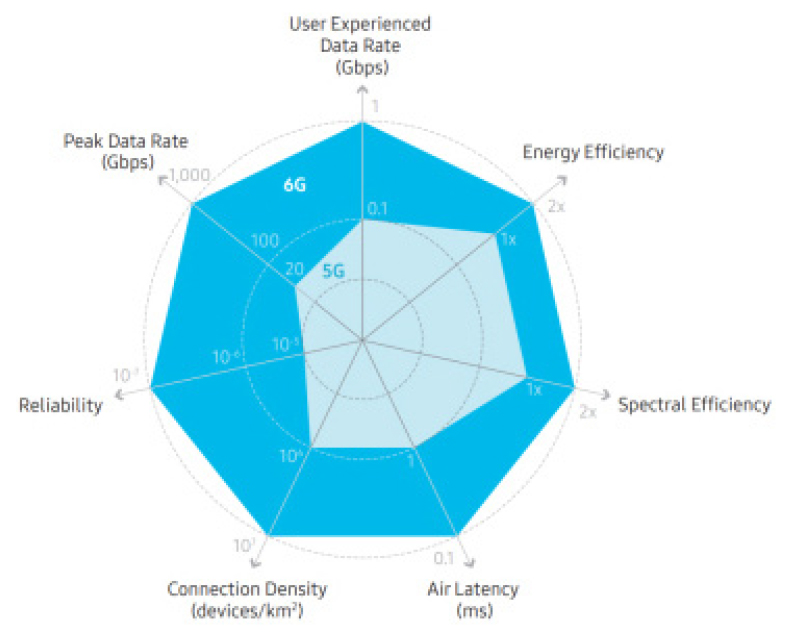
Next-generation communication systems such as 6G are focusing on achieving hyperconnectivity for the Internet-of-Things (IoT) and higher data rates for future applications, including extended reality (XR), digital twins, and so on, as shown in Fig. 1[1]. Realizing these requirements with traditional terrestrial networks is costly because the coverage of a base station is limited. This worsens as we move to higher frequency bands to obtain more bandwidth. The higher frequency bands require more base stations to be deployed due to higher path loss, which leads to higher costs. Academia and industry recognize LEO satellite communications as a significant candidate technology to provide flexible global coverage as well as meet high-performance requirements [2]. As a result, lots of research is underway to implement high transmission rate networks and develop transmission and reception techniques using LEO satellites.
Multi-beam transmission technology is required to achieve both hyperconnectivity and higher data rates using LEO satellites. Multi-beam transmission technology has been developed to allow efficient frequency reuse and high-broadband data rates across the coverage area as a cellular concept, in which each antenna on the satellite forms a different beam, just as conventional terrestrial cellular networks allocate different frequency resources to each cell. However, it is difficult to meet the high transmission rate requirements by assigning different frequencies to different beams as in cellular networks to avoid interference. Recently, significant attention has been attracted to assigning the same frequency band to each beam, as shown in Fig. 2, to allocate a wider bandwidth to each beam and obtain a higher transmission rate. If each beam simultaneously serves multiple users with the same frequency band, interference between users will be inevitable and a critical factor that can degrade overall performance.
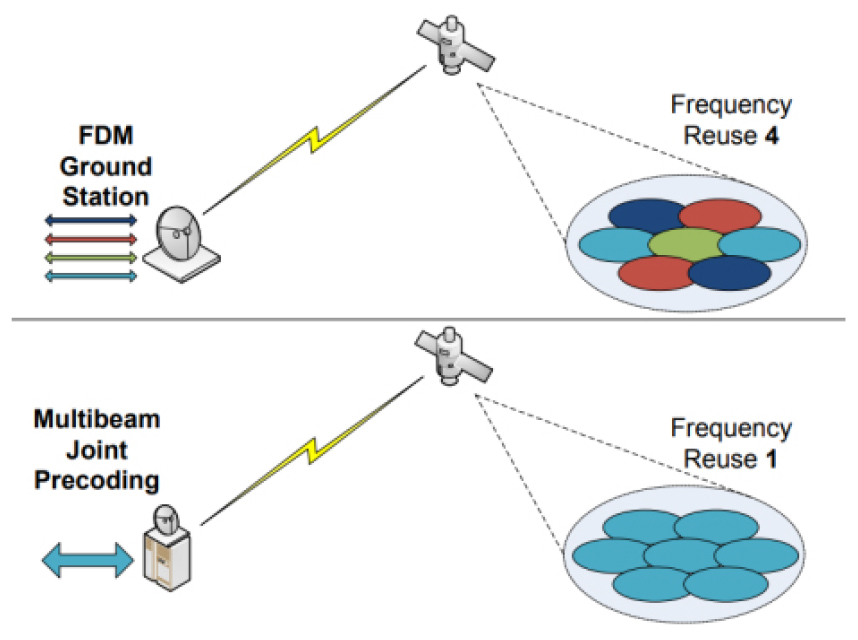
FIG. 2.
A multibeam satellite. Top: conventional 4-frequency reuse scheme. Bottom: multibeam using full frequency reuse [3].
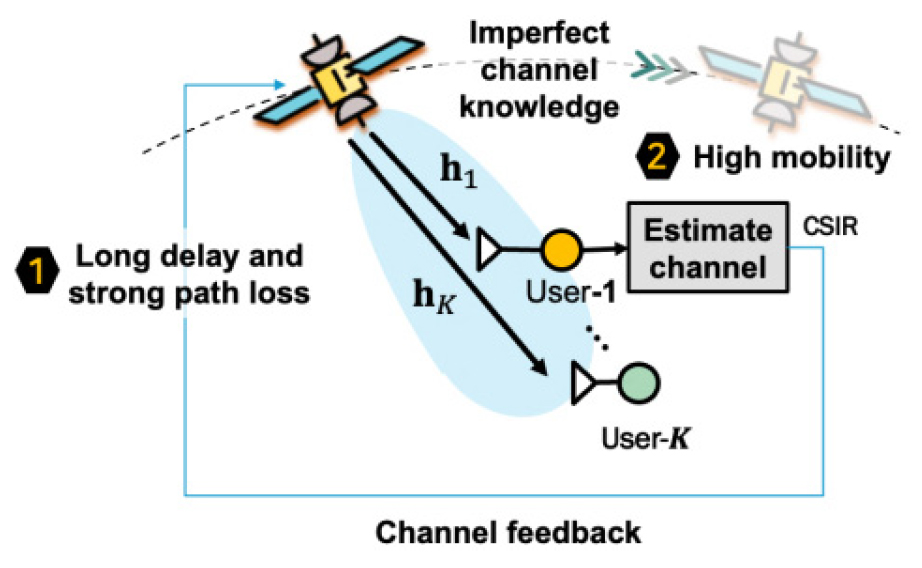
Therefore, to mitigate this interference, interference control techniques for multiple antennas are required. To achieve significant performance gains with multi-antennas, the spatial diversity must be generated by multiple paths, which is unusual in satellite communication due to the strong Line-of-Sight (LOS) characteristics. In addition, these techniques typically require channel information acquisition at the transmitter through feedback, which is difficult to obtain accurately due to the fast mobility and long propagation delay of LEO satellites. Furthermore, due to the limited power of solar-powered satellites, energy-efficient communication techniques are important to extend satellite lifetime and reliability.
In this paper, we attempt to survey the literature and resources over the last decade to investigate interference-controlled beamforming techniques, as well as reliable and energy-efficient communication schemes even with incomplete channel state information. Other key aspects of this survey paper are an interference control beamforming technique based on rate-splitting multiple access (RSMA) and a cooperative interference control technique for integrated satellite-terrestrial networks (ISTN). This paper is intended as an introductory survey of major recent developments in interference control in LEO satellite communication. As such, it is organized as follows. In section 2, we introduce multibeam satellite systems and related research issues to achieve a higher transmission rate and hyper-connectivity by full frequency reuse. In particular, we introduce the beamforming techniques under incomplete channel state information and rate-splitting multiple access to mitigate interference. In Section 3, we frame the problem of interference control in integrated networks. Finally, concluding remarks are given in Section 4.
2. RESEARCH ON INTERFERENCE MANAGEMENTS FOR SATELLITE COMMUNICATIONS
To achieve a higher transmission rate and hyper-connectivity using LEO satellites, multi-beam transmission technology is required, where each antenna on the satellite forms a different beam as each cell is allocated a different frequency band in a conventional cellular network [3]. In this case, it is difficult to provide high transmission rates to multiple devices simultaneously by assigning frequencies orthogonal to each other to mitigate interference. Therefore, the approach of assigning the same frequency band to each beam, as shown in Fig. 2, has been recently proposed [4,5,6,7,8]. This allows for a wide bandwidth but degrades overall communication performance and reliability due to increased inter-user interference. Therefore, interference control techniques with multiple antennas are essential for higher transmission rates, which require complete channel state information at the transmitter (CSIT). However, as shown in Fig. 3, the mobility of LEO satellites results in short channel coherence time and long propagation delay, which makes it difficult to obtain accurate CSIT in LEO satellite communications [5]. In addition, the limited power of solar-powered satellites requires energy-efficient communication schemes that can extend the lifetime of satellites and enhance system reliability [9,10,11,12].
This section introduces beamforming techniques and energy-efficient communication techniques that operate reliably under imperfect channel state information (CSI). We also introduce a satellite beamforming technique based on rate-splitting multiple access (RSMA) that enables more advanced interference control, as well as a cooperative interference control technique for integrated satellite-terrestrial networks (ISTNs).
2.1. SATELLITE BEAMFORMING TECHNIQUES UNDER IMPERFECT CHANNEL STATE INFORMATION
Since electromagnetic waves radiate in all directions, interference inevitably occurs when communicating with multiple receivers over the same time-frequency resource. To control this situation, the technique of preprocessing signals so that multiple copies of the desired signal are superposed constructively at each receiver, and the unwanted interfering signals are canceled destructively is called beamforming or precoding [13,14,15,16]. However, in LEO satellite communications, it is very difficult to obtain accurate channel state information due to the long propagation delay and mobility of the satellites, as shown in Fig. 3. Therefore, a beamforming technique should be carried out even with imperfect CSIT.
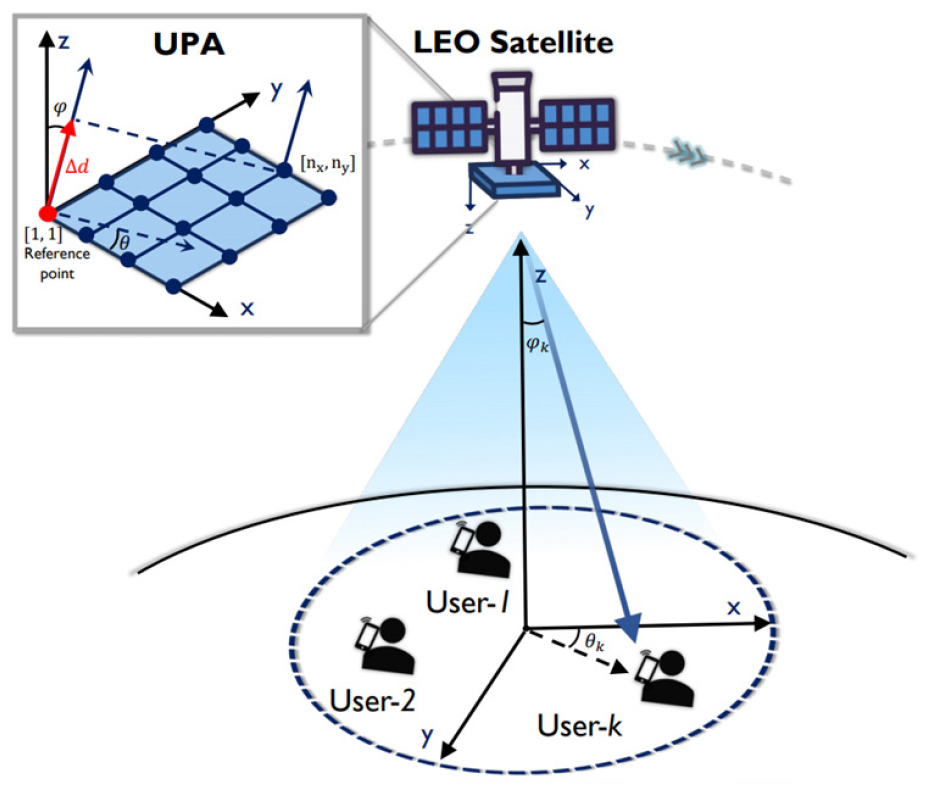
A beamforming technique that considers the impact of imperfect CSIT has been proposed in [17]. The paper assumed a satellite equipped with antenna feeds forming multiple beams and proposed a beamforming technique that minimizes total transmission power while ensuring a certain level of Signal-to-Interference-plus-Noise Ratio (SINR) for each user, taking into account channel estimation errors. Although this technique offers advantages such as providing desired transmission rates to users and ensuring energy efficiency, it faces challenges in direct application to LEO satellite scenarios [5]. proposed a beamforming technique using statistical CSIT for LEO satellite communication scenarios. The statistical CSIT refers to the average channel gain and the angle at which the user is positioned from the satellite’s perspective, as shown in Fig. 4. The study considered a satellite equipped with a uniform planar array (UPA) antenna and proposed a technique that maximizes the Average Signal-to-Leakage-plus-Noise Ratio (ASLNR), which is the ratio of the sum of power delivered to a specific user and power leaked to other users and noise power. Additionally, an angle-of-departure (AOD)-based scheduling technique for complete frequency reuse was suggested. However, a limitation of this research is that the proposed metric ASLNR for interference control succeeds only when the channel gains of users are similar. In scenarios where there is significant variation in channel gains due to differences in the performance of each receiving antenna and environmental factors, interference control may fail, leading to service unavailability for some devices [18]. proposed a zero-forcing (ZF) based beamforming technique utilizing partial channel state information to minimize interference in multi-beam satellite systems. This technique has the advantage of low complexity, leading to ease of implementation. However, a drawback is that when there are multiple users with similar channels, it can attenuate not only interference but also the power of the desired signal, making it suboptimal in terms of transmission rate [19]. proposed a beamforming technique that maximizes the total transmission rate by controlling interference among multiple users, considering both satellite and receiver equipped with multiple antennas using only statistical channel state information. However, a drawback of this technique is that it allocates low transmission rates to some users with relatively poor channel gain.
2.2. SATELLITE BEAMFORMING TECHNIQUES BASED ON RATE-SPLITTING MULTIPLE ACCESS
To provide reliable services to terrestrial users in satellite communications, a multiple access technique that can effectively utilize available resources and is robust to inaccurate CSIT is necessary. Rate-splitting multiple access, which is characterized by high energy-frequency efficiency and robustness to inaccurate CSIT, has recently been recognized as one of the promising multiple access technologies that can be used in satellite communications.
Rate-splitting multiple access (RSMA) has improved performance and robustness in multi-user multiple antenna communication under various channel environments [20]. In particular, RSMA has been shown to have significant performance gains over conventional multiple access techniques such as orthogonal multiple access (OMA), non-orthogonal multiple access (NOMA), and spatial division multiple access (SDMA) [21-22].
RSMA is characterized by dividing user messages into two types of common messages and private messages at the base station, as shown in Fig. 5. The K common messages are combined into one common message and encoded into one common data stream using a codebook shared by all users. Since the shared data stream is encoded using a codebook, it can be decoded by corresponding users. A private message, on the other hand, is encoded to a private data stream using a codebook for a specific user so only the addressed user can decode it.
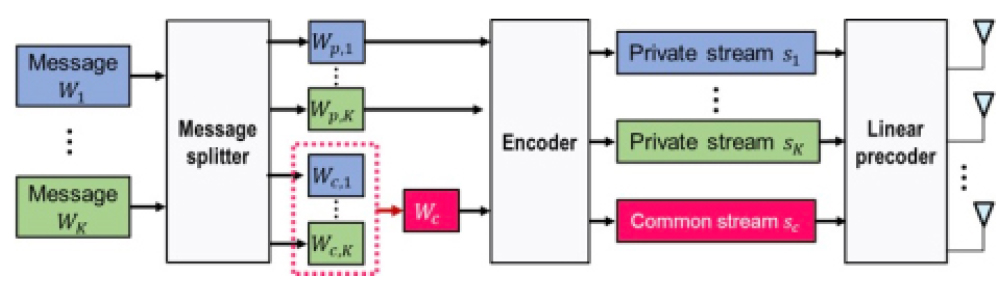
One common data stream and K private data stream are linearly encoded by a precoder and transmitted through the antenna of the base station. The user decodes the common data stream by processing the interference by the private streams as noise in the received signal as shown in Fig. 6 and extracts the message corresponding to the user from the decoded common messages. Finally, the user removes the common data stream from the received signal through Successive Interference Cancellation (SIC) to obtain a private data stream. The user then decodes the private data stream by processing the interference from other users’ private data streams as noise and removes the common data. The user constructs their message by combining the decoded common and private messages.
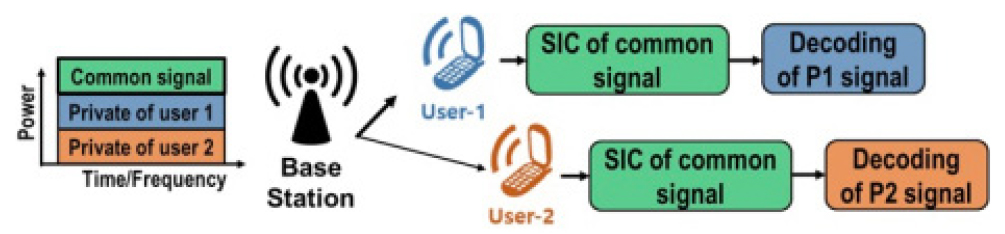
RSMA has the advantage of flexible interference control compared to conventional multiple access technologies by decoding a part of the received signals and processing the other as noise according to the ratio of common and private messages. Therefore, RSMA has characteristics of energy efficiency, frequency efficiency, and robustness to incomplete channel state information. Furthermore, RSMA can effectively control interference between users through common messages even when the number of transmit antennas is insufficient, while space division multiple access can control interference between users when the number of transmit antennas is sufficiently large compared to the number of users in the network. Because of these advantages, RSMA has been investigated in satellite communications with various performance metrics and has been shown to outperform other multiple access schemes. Multiple beam interference control of LEO satellites using RSMA has been actively researched.
In [23], research was conducted to maximize the minimum transmission rate among multiple groups based on RSMA in multibeam multicast satellite communications. Since one of the objectives of satellite communications is to improve the coverage area, it is important to provide a good transmission rate that is equal to all users within the coverage. A beamforming technique is designed to maximize the minimum transmission rate so that all groups in the coverage area can get an equally good transmission rate.
In [24], research was conducted to maximize energy efficiency when serving multiple groups of users based on RSMA in multibeam multicast satellite communications. It is assumed that the channel phase components are perturbed due to atmospheric attenuation, rainfall attenuation, etc. that occur over the feedback channel process. In [25], a beamforming design based on RSMA to meet the heterogeneous requirements of transmission rates among users in a wide coverage area was proposed. In order to meet the heterogeneous requirements of transmission rates among users, it is necessary to design beamforming flexibly according to user requirements, which is difficult to meet by increasing the network performance, such as maximization of the sum-transmission rate or minimum-transmission rate. It may result in a transmission rate that is less than the user’s required transmission rate and an unused transmission rate, which is the transmission rate provided over the user’s required transmission rate. The research designed beamforming to minimize the unsatisfied rate based on RSMA. However, to alleviate the optimization difficulty, [25] fixed the beamforming vector corresponding to the private stream as minimum mean squared error (MMSE) beamforming and then optimized the power allocation alone. For a more flexible beamforming strategy, the authors of [26] proposed an RSMA-based rate-matching framework that jointly optimizes power allocation/beamforming vector of common and private streams according to the heterogeneous traffic demands. By doing so, more effective traffic demand satisfaction with the limited radio resources at LEO satellites becomes possible.
In [27], leveraging the superior interference management capability of RSMA, an integrated sensing and communication (ISAC) framework for LEO satellite systems was proposed, allowing ubiquitous sensing functionalities in addition to communication. This framework was verified to effectively control interference not only among communication users but also between sensing and communication functions, demonstrating its ability to achieve good trade-offs between dual-function.
3. RESEARCH ON INTERFERENCE MANAGEMENTS FOR INTEGRATED SATELLITE-TERRESTRIAL NETWORKS
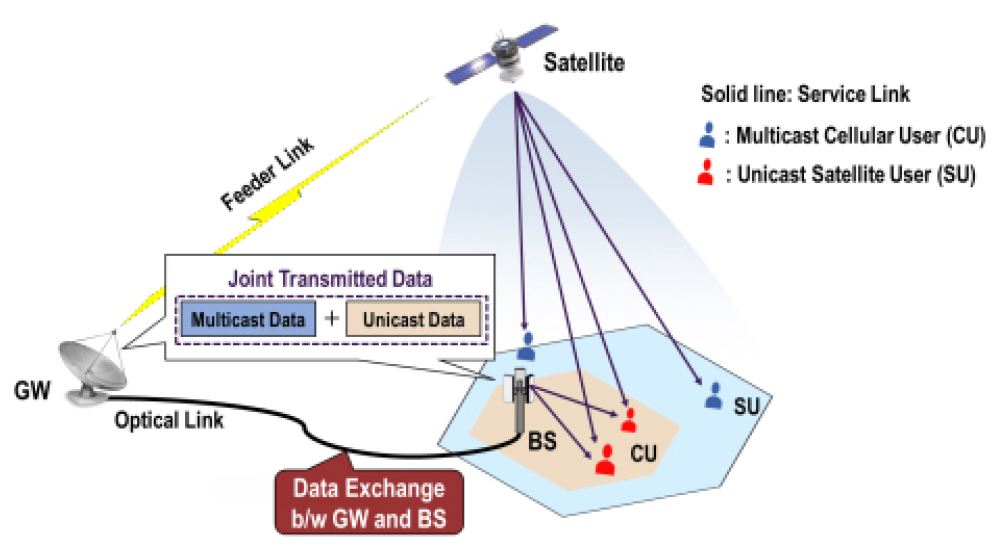
This section introduces a cooperative interference control technique for satellite-terrestrial integrated networks. Currently, terrestrial and satellite networks use different frequency bands. However, as communication systems continue to evolve, frequency scarcity is expected. Therefore, ISTNs are attracting research attention, in which terrestrial and satellite networks use the same frequency band and cooperate with each other as shown in Fig. 7 and 8. Unlike traditional terrestrial networks, ISTNs use a gateway as a control center to manage interference across the entire network, as shown in Fig. 8. However, since ISTNs use the same frequency-time resources, interference management between networks is a critical issue in addition to interference management within each network.

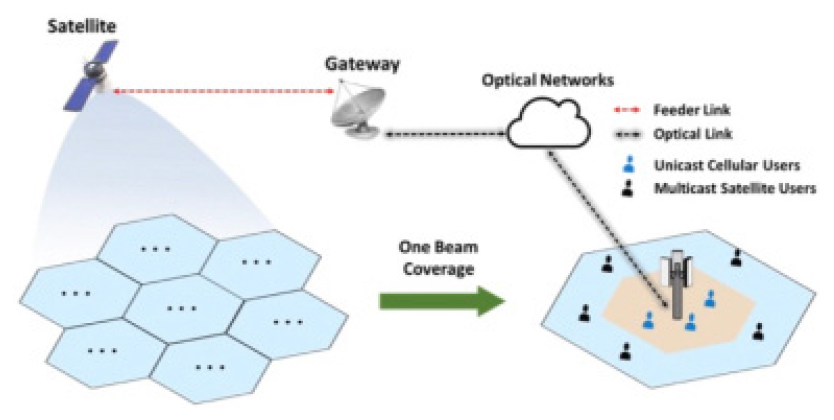
Satellite users are typically located in areas that are difficult to be served by conventional terrestrial networks. Therefore, the interference link from the ground base station to the satellite user does not need to be considered; however, the interference from the satellite to the cellular user within the satellite coverage area is likely to exist, which is an important factor in the beamforming design at the satellite side. To effectively address these intra- and inter-network interference issues, active research has been conducted on designing optimal beamforming for both satellite and ground base stations based on RSMA in satellite-terrestrial integrated networks. Specifically, research was conducted to design optimal beamforming to maximize the minimum transmission rate based on RSMA in ISTNs with two types of coordinated systems and cooperative systems [28]. It is assumed that the satellite side has incomplete channel state information due to perturbations in the channel phase components caused by atmospheric attenuation, rainfall attenuation, etc., that occur during the channel feedback process. In contrast, the base station on the ground has perfect channel state information.
In a coordinated system, the gateway designs the beamforming for each network, taking into account the channel state information of both satellite users and terrestrial users, as shown in Fig. 9. The gateway also considers all the multicast messages from each group to generate one satellite common message, which is encoded into one satellite common data stream using a codebook shared by all satellite users in coverage. Each group’s private messages are encoded as private data streams using a codebook shared only by the satellite users in each group. At the same time, the ground station considers all the unicast messages from the ground users and generates one terrestrial common message, which is encoded into one shared data stream using a codebook shared by all the ground users in coverage. A ground user’s private message is encoded as a private data stream using a codebook of the corresponding ground user. The satellite common data stream, each group’s private data stream, and beamforming vectors are then delivered to the satellite via a feeder link, and the beamforming vectors are delivered to the ground base station via an optical or wireless link. The satellite and the ground base station use the beamforming vectors to transmit data to satellite users and ground users, respectively. In coordinated systems, the satellite and ground stations share channel state information to design the beamforming vectors for each network to control signal interference within each network. However, due to the same frequency bands to provide services, interference from satellites to ground users located within satellite coverage still exists.

In a cooperative system, the gateway designs the beamforming vector by taking into account the channel state information of both satellite users and ground users, and the gateway and ground stations share messages over the optical link, as shown in Fig. 10. The gateway generates one common message by both multicast messages from each satellite group and unicast messages from ground users at once and it is encoded into one common data stream using a codebook shared by both satellite users and ground users. On the other hand, the private messages corresponding to each group and ground user are encoded into their own private data streams. The generated common and private data streams are then delivered to the satellite and the base station on the ground via feeder links and optical links, respectively. In this cooperative system, data is shared between the two networks in addition to channel status information. It is advantageous since valid data can be transmitted over the channel between the satellite and the ground user, whereas only signal interference occurs, allowing the satellite to control signal interference from the satellite to ground users located within the satellite coverage area. However, the disadvantage is that the system requires the satellite and the ground station to exchange data with each other, which incurs the overhead of data streaming.
In [29], a technique to control interference between networks without data exchange by adding a super common message that can be decoded by both satellite and terrestrial users to the existing coordinated system is proposed. The super common message can be decoded by both satellite users and ground users, but it contains valid messages only for satellite users as shown in Fig. 11. In other words, the gateway divides the multicast messages of each group into super common messages that can be decoded by both satellite users and ground users, satellite common messages that can be decoded only by satellite users, and private messages corresponding to each group. At the base station on the ground, messages from ground users are split into common messages that can only be decoded by ground users and private messages for each ground user. The gateway then delivers the super common data stream, the satellite common data stream, the private data stream of each group, and the beamforming vectors to the satellite through the feeder link, and also delivers the beamforming vectors for the shared data stream and the private data stream of the ground users to the ground base station through the optical link [29]. proposed a technique that allows part of the interference signal generated through the interference channel between the satellite and the ground users to be decoded by adding a super common message, so that the interference between the networks can be effectively controlled without data exchange.

4. CONCLUSION
We have presented a brief overview of multibeam satellite systems and looked at the latest research on interference control for multibeam satellite systems with a focus on a higher transmission rate and hyper-connectivity. We then introduced beamforming techniques under incomplete channel state information and rate-splitting multiple access to mitigate interference. We have extended the literature survey on integrated networks of terrestrial and non-terrestrial systems and focused on two types of coordinated systems and cooperative systems. Currently, the application of interference control in multibeam satellite systems is still in an early research stage without implementation and application. While there is still a long way to go on the road of realizing practical multibeam satellite systems, interference control in multibeam LEO satellite systems can be further utilized to meet the growing demands for high-speed, and reliable satellite communications in the future.