


1. INTRODUCTION
2. MATERIALS AND METHODOLOGY
3. RESULTS AND DISCUSSION
3.1. Key Principles of the Space Security Strategy
3.2. Strategic Goals
3.3. Exploration of a National Space Security Strategy
3.4. Space Surveillance Cooperation Governance and Strengthening the Space Surveillance Capabilities of National Security Agencies
4. CONCLUSION
1. INTRODUCTION
South Korea’s space activities have historically been pursued under fragmented goals, such as promoting space development, preventing space hazards, and enhancing national defense, with investments in budgets [1], technology development, and human resource training. Consequently, the imperative for strategic differentiation aligned with national security strategies and space security threats has emerged. This necessitates a government-wide approach to protecting space assets and activities from a comprehensive national security perspective [2,3]. Furthermore, the formulation of a space security strategy aligned with the national security strategy, including the defense space strategy and national cybersecurity strategy, has become essential [4]. South Korea, being exposed to regional space threats and North Korea’s nuclear threats, urgently needs to address these challenges effectively and propose a space security strategy at the national level, including space diplomacy [4].
Space security, however, extends beyond defense issues [5]. While space development in the past was government-led, in the New Space era, space development has shifted toward creating new technologies and markets for profitability, involving diverse actors, including governments, businesses, and individuals [6,7]. Thus, national space security encompasses not only military security but also economic and diplomatic security [8].
South Korea must develop a space security strategy that effectively responds to regional space threats and North Korea’s nuclear threats, creates future growth engines, revitalizes the space economy, and integrates space diplomacy. Establishing the roles of key stakeholders, such as the Ministry of Defense and intelligence agencies, within the space surveillance governance framework is equally crucial [9,10].
Against this backdrop, this study proposes a direction for South Korea’s space security strategy and governance that aligns with the “space security” paradigm of the New Space era. It identifies the direction and tasks for the establishment of a national space security strategy, builds cooperative governance among relevant agencies for space surveillance policies, and establishes measures to enhance the roles of intelligence agencies in space security [11]. By comprehensively examining the development status and competition dynamics of key technologies and major countries within the space security paradigm, the study aims to derive a space security strategy and actionable tasks suitable for South Korea’s space capabilities and environment.
2. MATERIALS AND METHODOLOGY
This study seeks to address the limitations of existing research on space security strategies and establish the direction of South Korea’s national space security strategy. By comprehensively examining the development trends and competition dynamics of new technologies and major countries within the space security paradigm of the “New Space Era,” it explores a macro-level policy direction for space security technologies that align with South Korea’s capabilities and environment.
Additionally, the study analyzes the current challenges in the Korean context under the national goal of emerging as a new space power amid intense competition in relevant technologies. It examines constraints and challenges in various fields and explores measures to foster new technologies—such as small satellites and air-launched vehicles—to counter competitive regional space technology developments and effectively address North Korea’s nuclear threats. This includes considerations for public-private cooperation, effective utilization and protection of private assets, and elements of technological advancement within the New Space paradigm.
To achieve these objectives, the study focuses on four major themes:
・Identifying the direction and tasks for formulating a national space security strategy.
・Establishing and operating bilateral and multilateral international space cooperation governance in the field of space surveillance.
・Enhancing the roles and capabilities of intelligence agencies in space surveillance.
・Building a space economy ecosystem linked to space security.
The study first analyzes the security environment and threats of the New Space Era. For the formulation and proposal of a national space security strategy, it investigates:
・Objectives and fundamental directions of the national space security strategy
・Development and acquisition of space security assets
・Strategies for promoting private space technology to create a space economy and industry
・Expanding space diplomacy with middle powers and emerging nations
・Deepening space security cooperation based on the U.S.-Korea alliance.
Regarding space surveillance governance, the study proposes:
・Building cooperative governance among related government agencies
・Operational strategies for space surveillance governance
・Public-private-military collaboration, including the roles of intelligence agencies in space surveillance.
To strengthen the roles and capabilities of national security agencies in space surveillance, the study examines the roles and responsibilities of the military and intelligence agencies, the importance of space surveillance activities in the New Space Era, and the necessity of intelligence agency-led initiatives [12,13]. It also analyzes case studies of space surveillance capability enhancement by major countries and explores measures to strengthen the capabilities of domestic security agencies through public-private-military cooperation.
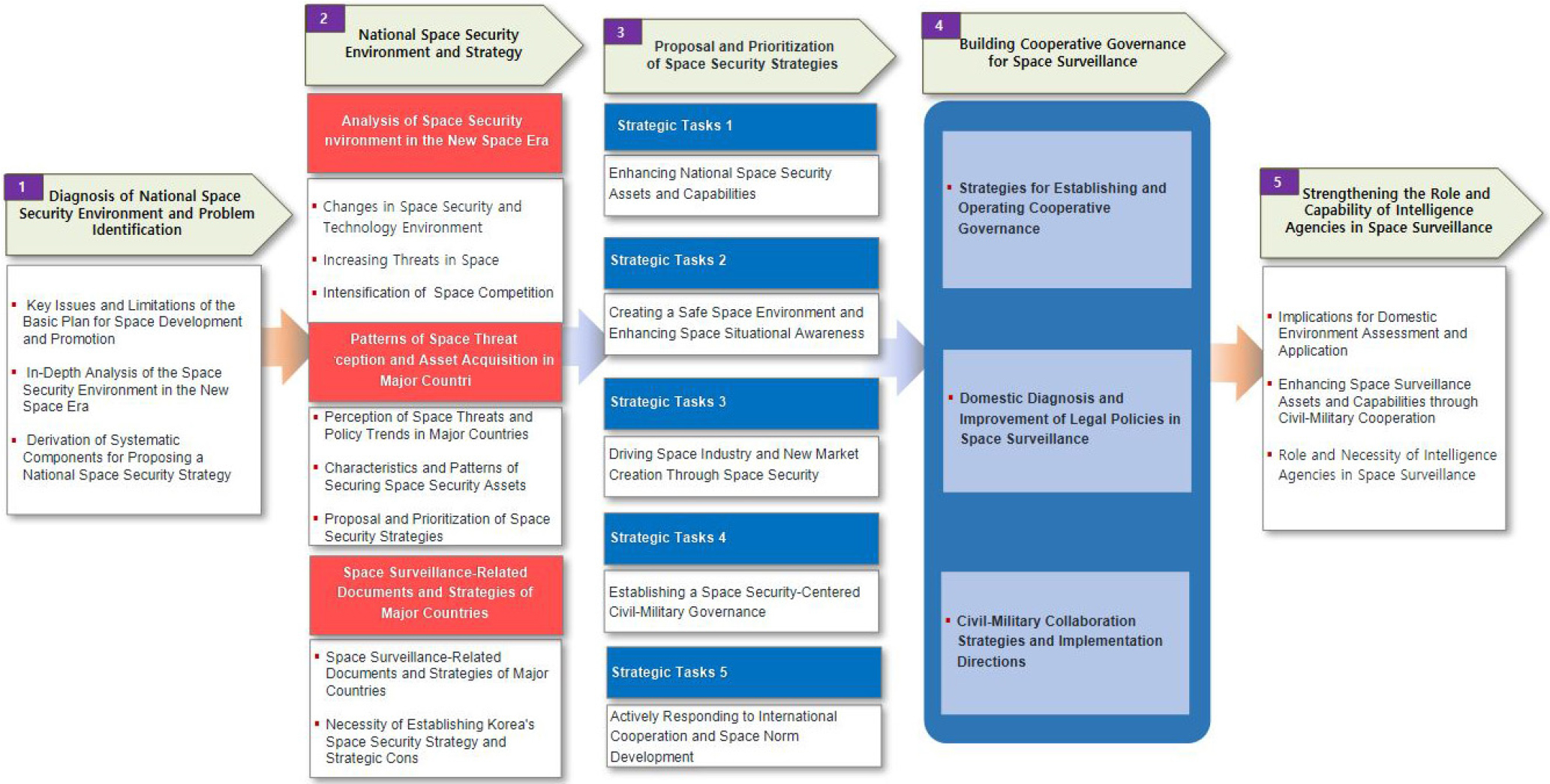
In summary, this study begins with diagnosing and identifying issues in South Korea’s space security environment. It then designs a fundamental framework for the national space security strategy, proposes priorities for the strategy, and derives measures for building space surveillance governance and enhancing the capabilities of intelligence agencies. Based on this detailed research plan, the study outlines a five- stage implementation framework (as illustrated in Fig. 1). This framework serves as the foundation for discussions and aims to propose actionable measures that strengthen the connection between national space strategies and real-world operations, particularly in the intermediate stages, with a focus on space surveillance governance and the enhancement of intelligence capabilities.
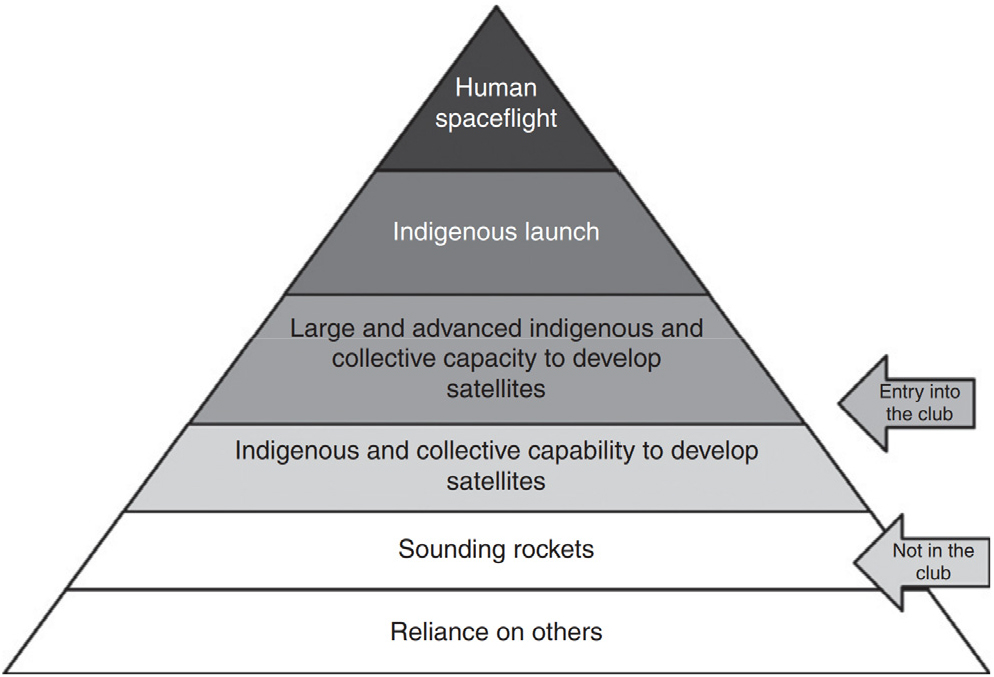
During the Cold War, the top tier of the “Space Club” was occupied by nations capable of sending humans into outer space [14]. The second tier included countries that could launch satellites into space. Following them were nations capable of developing and utilizing satellites, while the bottom tier consisted of countries that, like the European Space Agency (ESA), lacked sufficient domestic capabilities but could develop and utilize satellites through joint efforts [15]. Nations entirely dependent on the space capabilities of others were excluded from the Cold War-era Space Club [16].
The post-Cold War Space Club required reconfiguration. With advancements in space development and technology, the number of countries capable of developing and utilizing satellites increased. The costs of satellite development and utilization have decreased, and their use for commercial purposes, beyond government agencies, has created various markets. As a result, the distinctions between club members during the Cold War have become increasingly blurred. Instead of categorizing nations based on satellite development and utilization, the hierarchy is now primarily determined by the possession of launch vehicles and the capability for human spaceflight at the top tier, followed by countries possessing launch vehicles in the second tier [17,18]. The final tier includes nations capable of developing and utilizing satellites, either independently or in collaboration with other nations. Countries with capabilities below those of sounding rockets remain excluded from the post-Cold War Space Club.
To summarize, space superpowers are nations that perform most space activities, possess complete space systems including launch vehicles, and carry out space missions, as well as having human spaceflight capabilities. Examples include the United States, Russia, and China. Mid-tier space powers possess some space systems, including launch vehicles, and conduct space missions but lack human spaceflight capabilities. This group includes the European Space Agency (member states such as the UK, France, Germany), Japan, India, South Korea, Canada, Australia, and others, with their numbers steadily increasing. Emerging space nations lack launch vehicles but possess some space systems or are working on space missions. This hierarchy can be visualized as a pyramid [19].
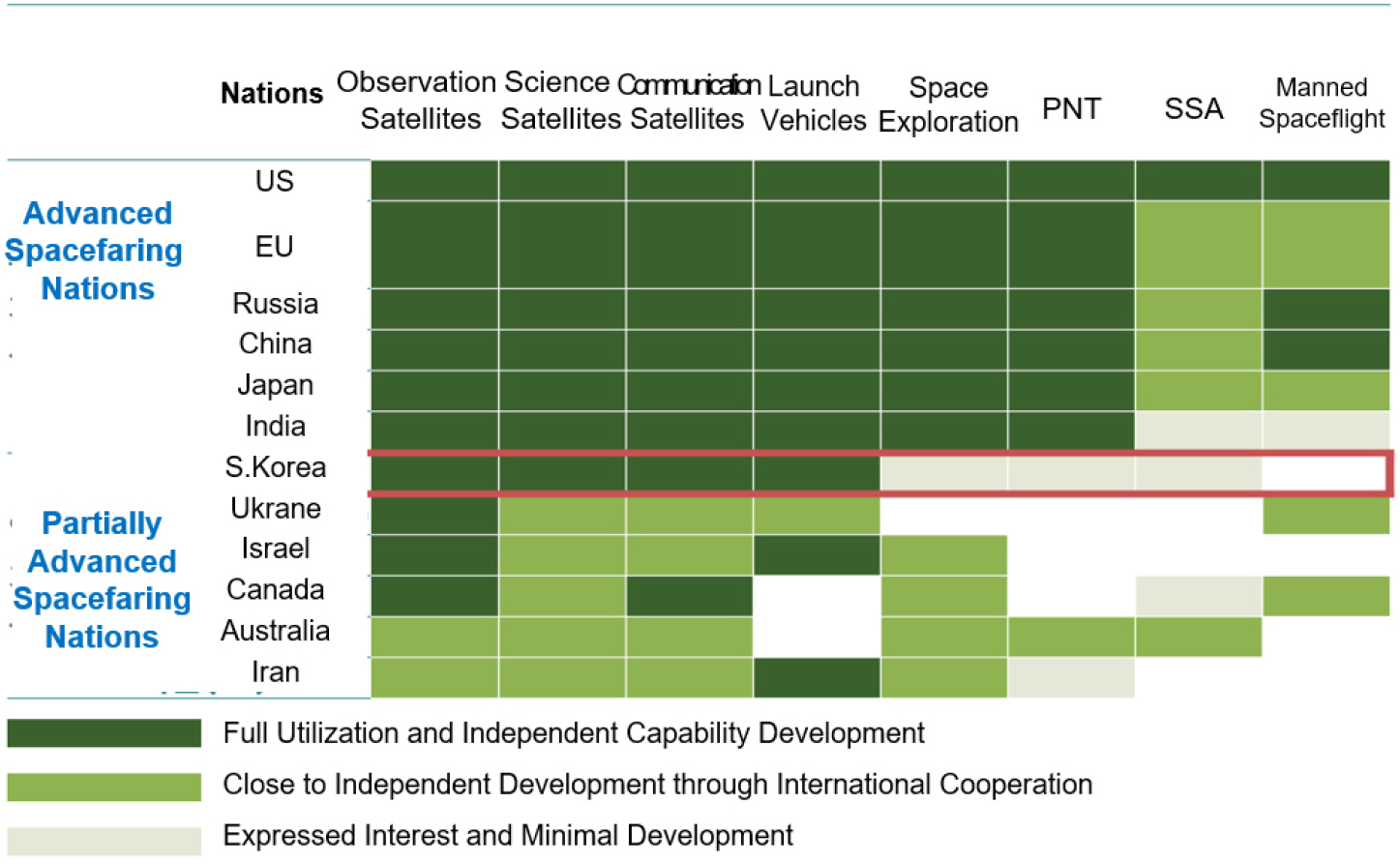
The Korea Institute of Science and Technology Policy (National Space Policy Research Center) also categorizes spacefaring nations based on space technology into two groups, as shown in Fig. 2: advanced spacefaring nations and countries leading in specific technologies. Advanced spacefaring nations are those that perform all or most space activities, ranging from earth observation satellites to human spaceflight. These include the United States, China, Russia, the EU (including the UK, France, Germany, etc.), Japan, and India, which belong to the categories of space superpowers and mid-tier space powers under the earlier Space Club classification.
Countries leading in specific technologies do not possess human spaceflight capabilities and perform only some or minimal space activities. These include South Korea, Australia, Canada, and Israel, which fall under the categories of mid-tier space powers and emerging space nations in the Space Club classification.
This study adopts this classification and divides spacefaring nations into space superpowers, mid-tier space powers, and emerging space nations. Space superpowers are nations that perform most space activities, possess complete space systems, including launch vehicles, and carry out space missions, as well as human spaceflight capabilities. Examples include the United States, Russia, and China. Mid-tier space powers possess some space systems, including launch vehicles, and carry out space missions, but lack human spaceflight capabilities.
Each country’s focus in strategic planning may vary depending on its geopolitical position, capabilities, strategic culture, and characteristics of foreign relations, necessitating efforts to establish appropriate methodologies. A comparative analysis of various defense planning methodologies used by the United States and European countries has been conducted by Dejan Stojkovic and Bjorn Robert Dahl in their work, “Methodology for Long Term Defence Planning [20].”
Particularly for middle powers like South Korea, defining threats itself poses the risk of creating adversaries, which may narrow the scope of potential cooperation. Since no one can accurately predict the future, it is necessary to develop a variety of strategies simultaneously to address uncertainty. Notably, Željko Dobrović proposed a metamodel for strategic planning under uncertainty, emphasizing an adaptive strategic planning procedure [20]. This approach involves conducting situation evaluations, assessing uncertainties, choosing strategic postures, and making decisions at critical junctures, all based on SWOT analysis. This study applies a capability-based strategic method to prepare for an uncertain future.
However, this is not fixed but is implemented alongside an adaptive strategic approach that reflects periodic changes, taking into account assessments of the space security environment and connections to the national security strategy. As the future lies in the realm of uncertainty, this study poses several key questions regarding the space security strategies of major nations:
・(Environment): What are the characteristics of the space security environment, and how will it evolve? (Threats): Who or what will threaten national security and space activities?
・(National Interests): What are the strategic vision and goals?
・(Capabilities): What tasks are required to achieve these goals?
3. RESULTS AND DISCUSSION
The national space security strategy objectives proposed in this study are: ▲ Strengthening national-level space security capabilities ▲ Ensuring the safety and sustainability of space activities ▲ Cultivating an autonomous ecosystem for the space economy ▲ Establishing international governance and cooperation for the peaceful use of outer space.
First, stable acquisition of national space security assets and capacity building are necessary to actively respond to space security threats. North Korea and neighboring countries’ space threats are already manifesting and becoming more visible, necessitating capabilities to maintain not only civilian space activities but also security space assets in a safe, stable, and sustainable manner. To this end, advancing Space Domain Awareness (SDA) capabilities is a priority, along with enhancing space capacity and utilization across multiple domains, such as the Korean Positioning System (KPS) and microsatellite systems.
Second, ensuring the safety and sustainability of space activities requires the establishment of a secure space environment and strengthening of the space domain awareness system. This includes efforts such as monitoring and responding to space debris, developing policies for disaster early warning and response systems using space information, and ensuring safety and efficient operations through Space Traffic Management (STM). Additionally, attention must be given to strengthening space-cyber capabilities and resilience, which are increasingly emphasized in current space security contexts.
Third, the creation of a virtuous cycle between space security and the space economy is essential to cultivate an autonomous ecosystem for Korea’s space economy. From a space security perspective, the application of civilian space technologies to space security and the mutual utilization of space information are required. From an economic perspective, considering Korea’s relatively small domestic space market as it aspires to become an advanced spacefaring nation, a reciprocal relationship between space security and the space economy is indispensable. This necessitates fostering the space industry ecosystem by revitalizing private space technologies and investments, ensuring a stable space industry supply chain, and creating new space markets by leveraging Korea’s strengths in advanced ICT and manufacturing technologies.
Fourth, Korea must play a leading role in establishing international space norms and strengthening international cooperation. Currently, international norms related to space are progressing slowly due to the strategic calculations of individual nation-states. While the UN General Assembly’s Committee on the Peaceful Uses of Outer Space (COPUOS) and the UN Disarmament Commission (DC) exist to deliberate on space security norms, they have not effectively reflected the diverse interests of individual nations. International cooperation trends show countries focusing on maximizing their interests through multilateral and bilateral partnerships, such as AUKUS and QUAD under U.S. leadership, as well as Southeast Asian, Middle Eastern, and China-centered collaborations. Korea must participate in the international norm-setting process to advocate for its position while building cooperative relationships with advanced spacefaring nations like the U.S., Australia, and India to create a favorable environment for enhancing space capabilities and expanding its influence.
3.1. Key Principles of the Space Security Strategy
The key principles of the space security strategy represent value-centered directions to achieve strategic objectives. These principles encapsulate methodologies for accomplishing the strategic objectives of space security. This study aims to apply the core concepts of “Innovation, Integration, and Proactivity” as strategic principles.
‘Innovation’ signifies the need to reflect the rapidly evolving security environment and technological advancements in the New Space era. As seen in the military space competition between the U.S. and China, space technologies for military purposes are becoming increasingly critical. For instance, rocket launchers serve as foundational technologies for hypersonic missiles, and reconnaissance satellites’ surveillance capabilities constitute vital space technologies with significant implications for rival states. Additionally, the fusion of space technologies with electromagnetic waves, lasers, and cyber technologies has rendered outer space increasingly hazardous. The transformative nature of space technologies is evident, as disruptive innovations expand space-based services, including communication, navigation satellites, weather forecasting, and scientific experimentation. Combined with national core technologies like artificial intelligence, 5G/6G communications, and big data, the pace of development is accelerating rapidly. Thus, ‘innovation’ must be prioritized when building national space security capabilities.
‘Integration’ refers to the harmonious alignment and interaction between space security and the space economy. One of the distinguishing features of the New Space era is the diversification of space actors. While government and state actors traditionally dominated space activities, commercial actors, such as companies, are now playing prominent roles. For example, SpaceX’s Starlink demonstrates that corporations are becoming significant actors in space security. These trends emphasize the need to move beyond the dichotomy between state-centered space security and privately-led space industries, fostering complementary or expanded interactions between these sectors.
‘Proactivity’ emphasizes Korea’s need for a leading and proactive role in international norms and cooperation. The establishment of international norms for outer space involves contentious areas that could trigger conflicts between advanced and emerging spacefaring nations. Given the need to reflect Korea’s position, proactive participation is required. Moreover, through bilateral and multilateral cooperation, Korea should aim to secure advanced space technologies, minimize trial-and-error, and reduce economic and temporal costs, thereby ensuring its practical benefits through systematic and active efforts.
3.2. Strategic Goals
Based on these three key concepts, this study proposes the following three strategic goals: ▲ The innovative advancement of national space security capabilities ▲ The creation of synergy between the space economy and national security ▲ Strengthened roles and active participation in the international community.
3.2.1. Innovative Advancement of Space Security Capabilities
This requires innovative advancements in space technologies. Efforts must be made to apply national core technologies, such as AI (automation), next-generation communications (5G/6G), quantum technology (cryptographic security), and big data (data analysis), to enhance space resilience and protect space assets. Through these technologies, Korea must strengthen space domain awareness for early detection of space asset threats, secure countermeasures against ASAT (anti-satellite) threats, and develop technologies for addressing space debris. Moreover, to address threats to space assets, satellite design must incorporate protection measures against signal jamming (e.g., encrypted satellite signals), laser attacks (frequency security and multiple filters), and microwave attacks (precision component application).
On the foundational side of space security capabilities, Korea needs to develop core technologies to respond to space threats and establish a governance system to strengthen space security. Legislative efforts are also required to systematically regulate space security, encompassing governance structures, asset launches, space traffic management, space domain awareness, space cyber defense, space policy, and new technology development. The most fundamental asset for achieving space security lies in cultivating specialized personnel. Strengthened government-wide efforts are required to train space security professionals across national, public, and private sectors.
3.2.2. Creation of Synergy Between Space Economy and National Security
Strengthening space security capabilities in the New Space era necessitates public-private cooperation. Korea’s current space security capabilities lag behind those of neighboring countries in both security and industrial dimensions. Bridging the technological gap with advanced spacefaring nations and achieving both objectives simultaneously requires complementary efforts. As seen in the relationships between NASA and SpaceX or JAXA and Mitsubishi, governments must incentivize private innovation and provide policy support, such as venture capital for startups. Overcoming challenges like the lack of foundational technologies in private companies, insufficient space professionals, limited technology transfer by government research institutes, and constraints on private investment necessitates policy establishment at the national level.
To generate synergy, there must be recognition of the nation’s space security and private space development capabilities as national assets, with concerted efforts to align these capabilities through civil- military cooperation. In conclusion, space security agencies must adopt and integrate innovative technologies to maintain security superiority in space while keeping pace with the private sector’s space development. Accordingly, agencies should work closely with startups, ventures, and innovative companies in the space industry to build a sustainable ecosystem.
3.2.3. Strengthened Roles and Active Participation in the International Community
Active participation in discussions on international norms is necessary to prevent exclusion from future negotiations on areas such as low-Earth orbit control, inter-orbit commercial services, and active removal of space debris. Since discussions on international norms for the space industry are likely to be U.S.-led, preemptive responses are required.
For instance, discussions on establishing international norms related to space debris and space traffic management (STM) are actively progressing, necessitating heightened attention. Additionally, Korea should ensure its interests by actively participating in UN and international organization efforts to protect space assets. For example, Korea should engage in norm-setting processes through platforms such as the UN General Assembly First Committee (International Security/Disarmament) and the Committee on the Peaceful Uses of Outer Space (COPUOS). A notable example is the adoption of a new space security resolution proposed by Korea and eight other countries during the 76th UN General Assembly First Committee in 2021, which received overwhelming support from 163 countries.
Furthermore, Korea should actively participate in multilateral space cooperation discussions centered on the UN while developing agendas and cultivating leadership on issues such as ASAT, space debris, and other emerging challenges. By engaging in initiatives such as the Artemis program and incorporating Korea’s strengths in advanced technologies like microsatellite development, Korea can accelerate its emergence as a significant space power.
3.3. Exploration of a National Space Security Strategy
To establish a national space security strategy, it is first necessary to expand the scope of space activities to be addressed. This scope should be categorized into broad, intermediate, and specific ranges to provide clearer guidelines. Specifically, the nation’s space activities should be divided into three broad areas: space security, space economy, and space diplomacy, with specific subcategories included within each. In particular, the precondition for establishing a “National Space Security Strategy” tailored to South Korea’s context is ultimately defining and setting the scope of application for the concept of space security that aligns with South Korea’s space security environment.
In addition, it is necessary to establish a direction for the stable acquisition and enhancement of national space security assets to proactively respond to space security threats. This aligns with creating a safe space security environment and strengthening the space situational awareness (SSA) system.
Furthermore, this should contribute to creating a virtuous cycle mechanism between space security and the space industry and include measures to diversify approaches for strengthening public-private cooperation ecosystems related to space security. Accordingly, governance considering public, private, and military stakeholders and multi-layered actors is required.
This study, therefore, focuses on three principles for establishing a mid-to-long-term vision for a space security strategy:
・Innovation: Aiming for innovative development of national space security capabilities.
・Integration: Creating synergistic integration between the space economy and national security in the era of the new economy and economic security.
・Proactivity: Actively seeking opportunities for South Korea’s role in advancing global space security.
To achieve these goals:
・Efforts must first focus on strengthening SSA capabilities and enhancing space utilization across multidimensional domains. In particular, South Korea must reinforce resilience and survivability against the rapidly increasing space security threats posed by neighboring countries and North Korea. Key assets include the Korean launch vehicle, small satellites, and the Korean space surveillance radar system.
・It is essential to establish a safe space security environment and lead the strengthening of the SSA system. With the explosive increase in low-Earth orbit satellites, policies and resources are required to mitigate space debris and address hazards. For instance, issues related to space weather phenomena (e.g., solar wind, coronal mass ejections) and active removal of space debris must be addressed. Measures such as ionospheric monitoring and solar activity data analysis should be implemented to counter communication disruptions caused by solar storms and related damages.
・A mutually reinforcing cycle between space security and the space industry is needed. The national space security strategy must prioritize revitalizing the space industry and exploring new markets. South Korea’s current space capabilities lag behind those of advanced nations in both security and industrial aspects. To reduce this gap and achieve dual goals in security and industry, mutually reinforcing efforts in these areas are necessary.
・Public-private cooperation ecosystems related to space security must be strengthened, and implementation approaches diversified. This involves fostering an ecosystem for public-private cooperation to enhance space security capabilities and contribute to space industry development. Additionally, diverse policy tools and methods for government support and lessons learned from foreign examples should be adopted.
・Comprehensive governance for space security is required. This includes public-private-military collaboration, improvements in legal and institutional frameworks related to space security assets, and training specialized personnel. A centralized space security control tower is also necessary to manage the diverse governance elements cohesively.
・Space diplomacy must be strengthened, and South Korea should assume a leading role in establishing international norms. To reduce the time, costs, and technological constraints associated with space development and market expansion, the U.S.-Korea alliance must be leveraged. Furthermore, bilateral partnerships with countries like Japan, Australia, India, and the EU should be expanded to create a favorable environment for space security.
Fig. 3 summarizes our vision and goals.
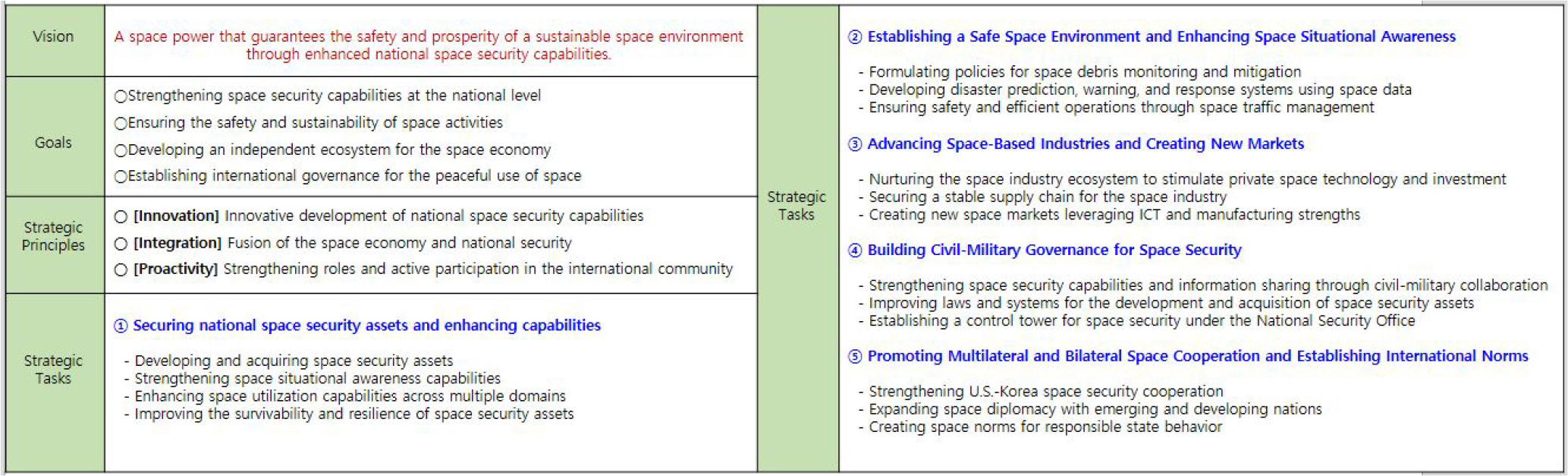
Ultimately, this vision indicates the need for South Korea to aim to become a “space powerhouse” that ensures the safety and prosperity of a sustainable space environment, grounded in enhanced national space security capabilities. As shown in Fig. 4, South Korea is the seventh-developing space nations in the world, having achieved everything from Earth observation capabilities to launch vehicle development.
Strategic tasks to realize this vision include (as illustrated in Fig. 3):
・Strengthening space security capabilities at the national level.
・Ensuring the safety and sustainability of space activities.
・Developing a self-sustaining ecosystem for the space economy.
・Establishing international governance for the peaceful use of space.
First, to secure and enhance national space security assets, tasks such as developing and acquiring space security assets, strengthening SSA capabilities, enhancing space utilization across multiple domains, and improving the survivability and resilience of space security assets must be supported. Second, to establish a safe space environment and strengthen the SSA system, policies for space debris monitoring and mitigation, disaster prediction and warning systems using space information, and efficient space traffic management must be implemented. Third, to advance space-based industries and create new markets, fostering the space industry ecosystem through private space technology and investment, securing stable space industry supply chains, and leveraging South Korea’s ICT and manufacturing strengths to activate space businesses are necessary. Fourth, public-private-military governance contributing to space security must be based on cooperation to strengthen space security capabilities and share space information. This requires legal and institutional improvements for the development and acquisition of space security assets, as well as the establishment of a space security control tower under the National Security Office. Finally, efforts must focus on enhancing multilateral and bilateral space cooperation and establishing international norms. This includes strengthening U.S.-Korea space security cooperation, expanding space diplomacy with emerging and developing nations, and creating norms for responsible state actions in space.
3.4. Space Surveillance Cooperation Governance and Strengthening the Space Surveillance Capabilities of National Security Agencies
As shown in Fig. 4, South Korea’s space security capabilities are positioned between those of Advanced Spacefaring Nations and Partially Advanced Spacefaring Nations. Additionally, South Korea’s space monitoring currently focuses more on space risks rather than space threats. In other words, from Korea’s perspective, the concepts and types of space threats remain ambiguous, and space risks are approached mainly from a disaster response perspective. In the future, space monitoring for space security should address both threats and risks, with a gradual shift of focus toward threats. To achieve this, securing a space surveillance radar is urgently needed.
Space surveillance radar needs to be pursued as a multi-agency project for several reasons. Space objects in orbit, whether currently operational or decommissioned, fall under the purview of space monitoring regardless of their purpose (military, security, commercial, or scientific) or the managing agency. Such radar is inherently a dual-use technology for both civilian and military purposes [21]. The core components of space surveillance radar are subject to U.S. export control laws [22], leading to high costs and extended development timelines, necessitating collaboration among relevant agencies.
A proposed framework suggests that the operation of a Military Space Situational Awareness Center (tentative name) should be managed by a Security Space Development Task Force, co-chaired by the Vice Minister of Defense and the Deputy Director of the National Intelligence Service. According to UN data, while 2,470 satellites were launched in 2022, the number of satellites projected for launch in 2028 alone is an astonishing 1,119,866 [23].
Statistics from the European Space Agency (ESA) reveal that approximately 19,590 satellites have been launched since the beginning of human space exploration, with about 10,200 operational as of 2024 [24].
Regarding space debris, there are approximately 40,500 pieces larger than 10 cm, about 1,100,000 pieces between 1 cm and 10 cm, and about 130 million pieces between 1 mm and 1 cm [25]. However, the U.S. Space Surveillance Network (SSN) regularly tracks only about 36,860 space objects, including space debris [26].
Therefore, 24-hour space monitoring using radar is essential to ensure the safe operation of South Korea’s space assets against space threats and risks. Agencies with extensive experience in operating radars, such as for missile early warning, would be most efficient in maintaining the equipment. The Ministry of National Defense (Air Force) is already receiving information from the U.S. Department of Defense regarding the tracking and monitoring of space objects. If Korea establishes its radar system, the defense ministries of both countries could exchange precise space surveillance information for security purposes. Starting in 2025, Korea’s Ministry of National Defense plans to participate in the U.S. Joint Combined Operations Cell (JCO Cell). By the 2030s, most of Korea’s space assets are expected to serve security purposes, including national defense, necessitating the Security Space Development Task Force’s oversight of space surveillance assets like radar. Additionally, space surveillance information should be shared with related agencies to the greatest extent possible.
Globally, the number of satellites operated by private companies for commercial purposes is rapidly increasing. Considering the situation where South Korean private companies are operating satellites independently, it is necessary to establish a government-led National Space Situational Awareness Center (tentative name). This center would integrate space surveillance capabilities and data from government research institutions, private companies, and other entities.
To ensure the safe operation of domestic space assets across the public, private, and military sectors, it is essential to combine military space surveillance data with data from civilian and governmental sources. In the short term, a system should be developed to share information between the National Space Situational Awareness Center (tentative name) and the Military Space Situational Awareness Center (tentative name). In the mid- to long-term, a unified system integrating the data from both centers should be established.
In advancing the implementation of the National Space Security Strategy, the first critical component is establishing governance for utilizing space surveillance assets. Currently, South Korea lacks comprehensive laws and national policies that address space surveillance and situational awareness in an integrated manner. Existing frameworks, such as the Space Development Promotion Act and the Basic Plan for Space Hazard Response, address space hazards only as a partial element of space surveillance. Article 2 of the Space Development Promotion Act defines space hazards as “risks associated with the fall or collision of space objects in outer space.” Similarly, the Second Basic Plan for Space Hazard Response mentions risks to public safety and space assets caused by artificial or natural space objects, solar activity, or space operations.
In the New Space era, addressing space risks and threats requires a correct understanding and judgment of the role of national security institutions in the field of Space Domain Awareness (SDA), as well as the reinforcement of governance systems, expansion of SDA space assets, and improvements to operational systems. Fortunately, the government’s Defense Innovation 4.0 initiative emphasizes strengthening defense space capabilities, with the development of space surveillance radars being one of the key discussions. This effort involves collaboration between civilian and military specialized institutions and defense companies to jointly develop advanced multifunctional space surveillance radars, which is expected to provide a technological boost.
Through the “Air Force Space Power Development Plan – Space Odyssey 2050,” the military aims to enhance the conditions for conducting space operations and develop all-weather space surveillance capabilities by strengthening surveillance and reconnaissance to prepare for comprehensive space threats.
The plan is structured into four phases:
・Phase 1 (by 2030): Establish SDA capabilities to ensure conditions for space-based surveillance and reconnaissance operations.
・Phase 2 (by 2035): Secure advanced space awareness capabilities and develop space information support and space control capabilities.
・Phase 3 (by 2040): Acquire space power projection capabilities and strengthen space control execution capabilities.
・Phase 4 (by 2050): Expand capabilities for space power projection and space control to a fully operational level.
These efforts highlight the military’s role and commitment to strengthening national space security capabilities, as discussed at the 2024 Space Security Forum organized by the Korean Military Science and Technology Society and the Korea Space Security Society (Jang Sung-gyu, Director of the Air Force Space Center).
As examined, the importance of national security institutions’ space surveillance activities in responding to the rapidly increasing space threats in the New Space era is directly tied to national security. Advanced spacefaring nations like the United States are mobilizing all available national assets to enhance space surveillance capabilities. Similarly, despite South Korea’s limited resources and capabilities, the present moment demands strategic wisdom to efficiently grow its space security capabilities.
However, from a national security perspective, the ultimate purpose of space surveillance is to prevent accidental or intentional harm that could undermine the safe operation of space systems. As such, space surveillance must encompass not only South Korea’s national and public space objects but also space objects owned by private companies registered under the South Korean government. The government must therefore access information about satellites operated by private companies as well as the surveillance data and assets these companies independently manage. Given that the assets and information required for space surveillance differ between the defense and civilian sectors, it is necessary to establish institutions to oversee civilian and military space surveillance respectively. Once established, a system for exchanging and integrating information between these institutions must be developed. This system should be grounded in the National Space Committee under the Space Development Promotion Act and include working committees for space development promotion and security space development.
The second critical component is strengthening the roles and capabilities of national security agencies, such as the National Intelligence Service (NIS), in the space surveillance sector. National security-related organizations, including the military, have historically played a leading role as the primary consumers of space projects and strategies. In the New Space era, their roles in space surveillance must expand. The NIS, as the control tower for the National Space Security Strategy, must strengthen its capacity to effectively support the National Security Office. This includes securing budgets to enhance precision satellite assets and advanced equipment, actively supporting multi-agency projects, and reinforcing internal organizations and personnel for Space Domain Awareness (SDA). Additionally, the National Satellite Operation Center must improve its management of space information data and enhance inter- agency data-sharing systems to optimize the use of big data on space hazards across the civilian, governmental, and military sectors. Strengthening the center’s operations is critical to this mission.
The NIS must also assume an active role in systematically managing domestic and international space assets across the civilian, governmental, and military sectors, expanding the use of the National Satellite Operation Center as core infrastructure. Through this, space information data can be continuously accumulated, managed, and analyzed at the national level, enabling early detection of space threats, precise analysis of hazard factors, and improved SDA capabilities. Moreover, South Korea must maximize its use of the national space innovation system, including supporting the establishment of a Space and Aeronautics Agency and fostering collaboration among central and local governments, academia, and industry.
Lastly, it is essential to broaden the horizon of space security by expanding bilateral and multilateral cooperation with allied nations. This includes promoting international space diplomacy, adhering to space security norms, and strengthening South Korea’s capabilities to become a leading space nation.
Ultimately, these efforts will position South Korea as an active and responsible participant in the international space community.
4. CONCLUSION
The objectives proposed by this study for the National Space Security Strategy include strengthening space security capabilities at the national level, ensuring the safety and sustainability of space activities, fostering a self-reliant ecosystem for the space economy, and establishing international governance and cooperation for the peaceful use of space.
To achieve these objectives, it is essential to secure and enhance national space security assets to proactively respond to space security threats. With space threats from North Korea and neighboring countries already present and becoming more visible, it is critical to ensure the safety, stability, and sustainability of South Korea’s civilian space activities and security space assets. Advancing Space Domain Awareness (SDA) capabilities constitutes a priority, as does enhancing space capabilities and utilization across multiple domains, including the Korean Positioning System (KPS) and small satellite systems.
It is also necessary to establish a safe space environment and strengthen SSA systems to ensure the safety and sustainability of space activities. This includes formulating policies for space debris monitoring and mitigation, utilizing space information for disaster forecasting and response, and ensuring safe and efficient space traffic management. Attention must also be given to emerging space-cyber risks and improving system resilience. Through the creation of a virtuous cycle between space security and the space economy, South Korea can develop a self-reliant ecosystem for the space economy. From a space security perspective, applying private space technologies to space security and promoting mutual utilization of space information are necessary. From an economic perspective, South Korea must address the limited scale of its domestic space market by fostering synergistic connections between space security and the space economy.
Furthermore, efforts must focus on fostering international collaboration and playing a leading role in the establishment of international norms for space security. While international discussions on space-related norms progress slowly due to differing national interests, South Korea must actively participate in rule- making processes to advocate for its stance. At the same time, partnerships with advanced spacefaring nations, such as the United States, Australia, and India, should be strengthened to enhance South Korea’s space capabilities and expand its global influence.