


1. INTRODUCTION
2. DEFINITION AND RELATED STATUS
3. SPACE SECURITY & SECURITY PLATFORM
4. SPACE SECURITY & MANAGEMENT SYSTEM
5. EXAMPLES OF SPACE SECURITY IN MAJOR COUNTRIES
5.1. United States
5.2. Japan
5.3. Korea
6. ISSUES RELATED TO SPACE SECURITY
6.1. Development and Production Phase
6.2. Launch Phase
6.3. Operational Phase
6.4. Disposal Phase
6.5. Security Strategy for Industry-Academia-Research Participation
6.6. Security Topics for Space Systems
7. SPACE SECURITY GUIDELINES (DRAFT)
8. SPACE SECURITY STRATEGY
8.1. Cyber Threats and Countermeasures in Space
8.2. Enhancing Security for Proprietary Satellite Assets
8.3. Strengthening Space Control
9. CONCLUSION
1. INTRODUCTION
Space security represents the aggregate of all technical, regulatory and political means that endeavor to ensure unhindered access to and use of outer space while safeguarding against any interference and simultaneously leveraging space capabilities to enhance terrestrial security.
This research aims to advance the establishment of robust space security operation systems through systematic analysis of security elements inherent in space system operations, culminating in the formulation of security measures, particularly comprehensive guidelines, applicable throughout each phase of the space system life cycle.
2. DEFINITION AND RELATED STATUS
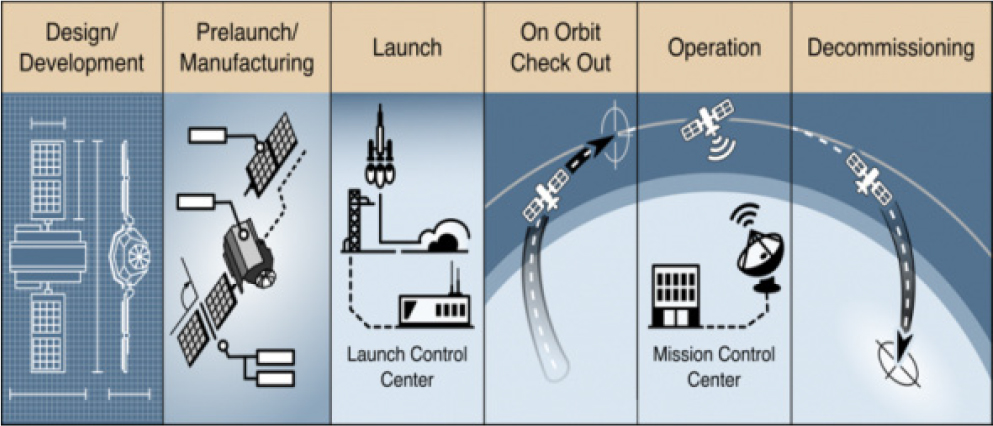
Security encompasses the constellation of policies, procedures, and technologies deployed to protect information, assets, systems, and infrastructure from both external threats and internal vulnerabilities. Within the context of this investigation, space security denotes the comprehensive protection and sustained maintenance of data, information, and assets within space systems (ground sector, space sector, link sector, user sector) throughout the complete life cycle of space objects (development/launch/operation/disposal/recycling) against diverse threat vectors including physical security breaches (general security), administrative security lapses (research security), technical security vulnerabilities (information security: communication security, computer security, network security, internet security), cybersecurity incursions, and both internal and external threats (active/intentional threats, space debris, space weather, natural space objects) (Fig. 1) [1].
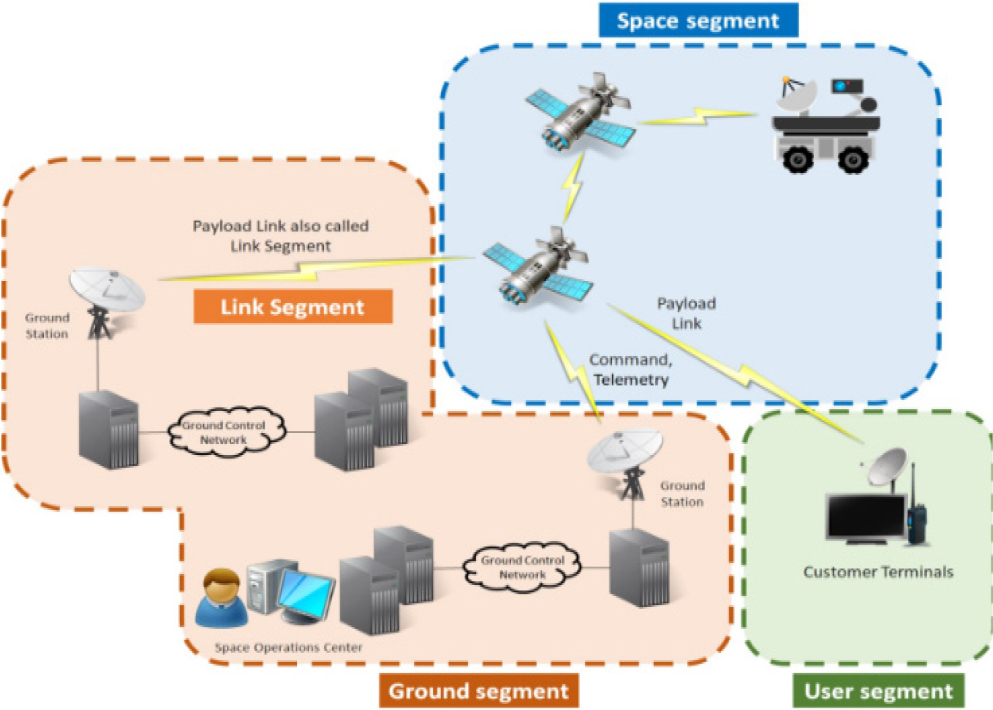
Space security frequently overlaps conceptually with space defense and space safety. The concept has evolved into a broad framework that encompasses space defense within the defense sector and space safety within the private sector. Security may be conceptualized either as synonymous with safety (in its broader interpretation) or as a distinct domain of security. UNIDIR’s definition of space security adopts an expansive interpretation, positioning space security as a comprehensive response framework addressing the full spectrum of space threats [2].
The Space Security Index (SSI) employs an inclusive definition of space security that integrates three fundamental dimensions: the sustainability of the unique space environment, the preservation of physical and operational integrity of man-made objects in space and their ground stations, and the protection of Earth from threats and natural hazards originating in space (Fig. 2).
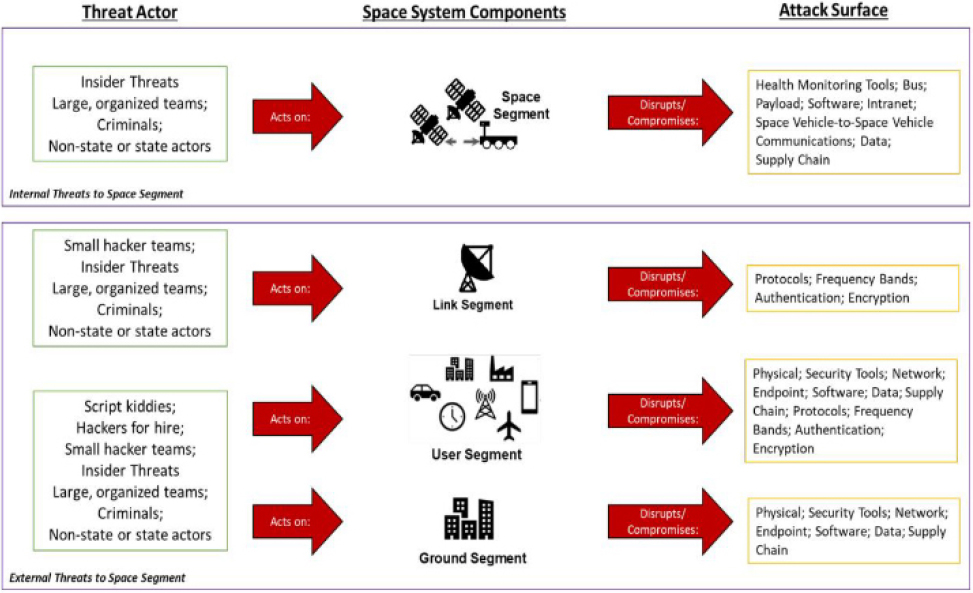
Space security assumes critical importance for fostering industrial development. Satellite communication applications constitute the primary driver of future market demand.
Telecommunications represents one-third of the total market valuation of $400 billion, with two- thirds of satellites scheduled for launch in 2019, positioning telecommunications as the dominant satellite application throughout the next decade. Projections indicate that 18,634 satellites will be launched for satellite communications, with 95% designated for deployment within five super- constellation systems providing broadband connectivity. Security emerges as the second-largest market for satellite applications, valued at $162 billion, encompassing applications such as SSA, missile defense, and ELINT, with payload architectures increasingly adopting satellite constellation designs and/or incorporating sophisticated, high-value satellites [3].
3. SPACE SECURITY & SECURITY PLATFORM
CCSDS delineates potential impacts, probabilities, and security mechanisms corresponding to each mission-specific threat. Threats confronting space missions include state and non-state actors such as terrorists, foreign intelligence agencies, and cyber intruders. Internal vulnerabilities arise from improper maintenance protocols, compromised system personnel, disgruntled employees, and negligent employee behavior. Environmental hazards encompass natural and man-made disasters, pandemics, space weather, space debris, and power infrastructure failures. Structural vulnerabilities include software and hardware malfunctions [4].
The National Institute of Standards and Technology (NIST) has promulgated comprehensive standards and guidelines acknowledging the critical role of information security within national security frameworks under the Federal Information Security Management Act (FISMA) of 2002.
The framework comprises seven sequential phases: Prepare (executing essential activities that position an organization to effectively manage security and privacy risks**), Categorize (systematically classifying** systems and information based on comprehensive impact analysis**), Select (identifying appropriate** NIST SP 800-53 controls through risk assessment**), Implement (deploying** controls while documenting implementation methodologies), Assess (validating control effectiveness and evaluating outcome generation), Authorize (enabling administrators to execute risk-based operational decisions**), and Monitor (maintaining continuous** risk surveillance across system operations).
The National Cyber Security Center of Excellence (NIST) has published NIST Interagency Report (NIST IR 8441: Cybersecurity Framework Profile for Hybrid Satellite Networks) [5].
4. SPACE SECURITY & MANAGEMENT SYSTEM
ESA has developed SPACE-SHIELD (Space Attacks and Countermeasures Engineering Shield). Within this framework, threats are hierarchically structured with Tactics at the highest level, supplemented by detailed Techniques and Sub-techniques for each tactic. The framework comprehensively catalogues all potential threats capable of impacting space systems, while presenting actionable mitigations for each identified threat (Fig. 3).
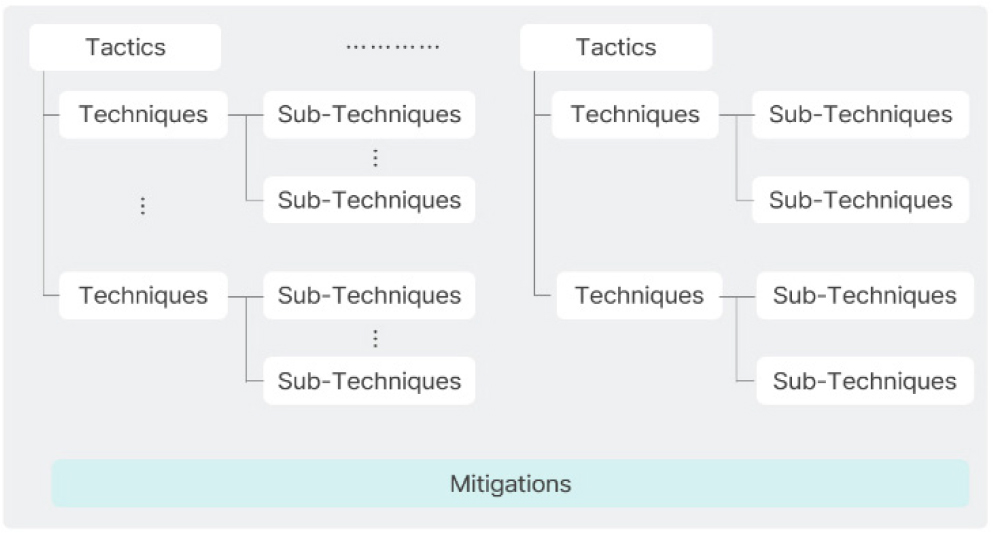
The Aerospace Corporation has developed the Space Attack Research & Tactic Analysis (SPARTA) framework, incorporating a Depth-in-Defense (DiD) model specifically tailored for space systems. The prevention layer constitutes the outermost defensive perimeter, with sub-layers encompassing human security awareness, internal threat mitigation, security assessments, threat analysis, training, and supply chain integrity (Fig. 4).
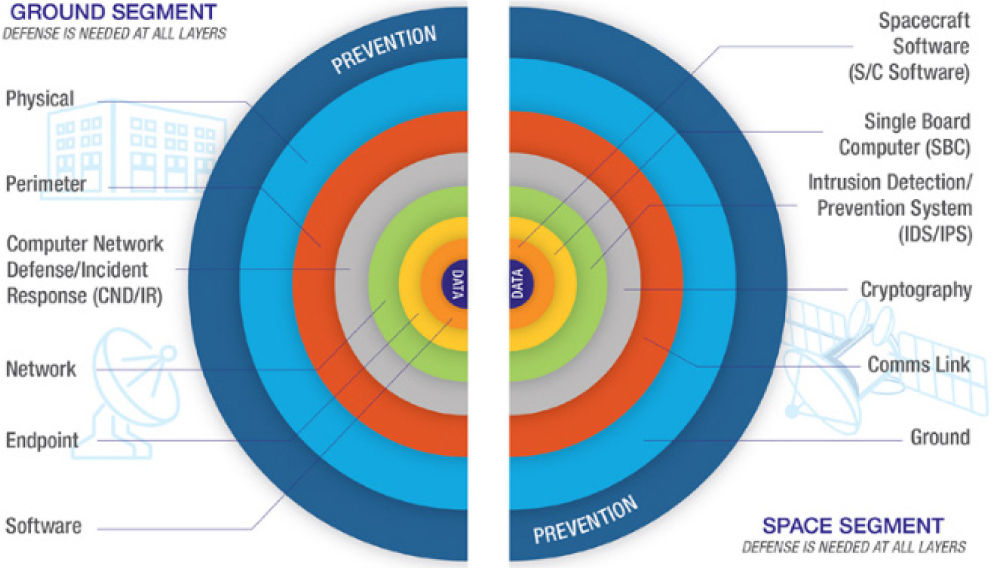
As terrestrial infrastructure becomes increasingly interconnected through space, air, land, and maritime networks utilizing satellite communications technologies, the imperative for robust security technologies capable of neutralizing cross-layer cyberattacks intensifies commensurately (Fig. 5).
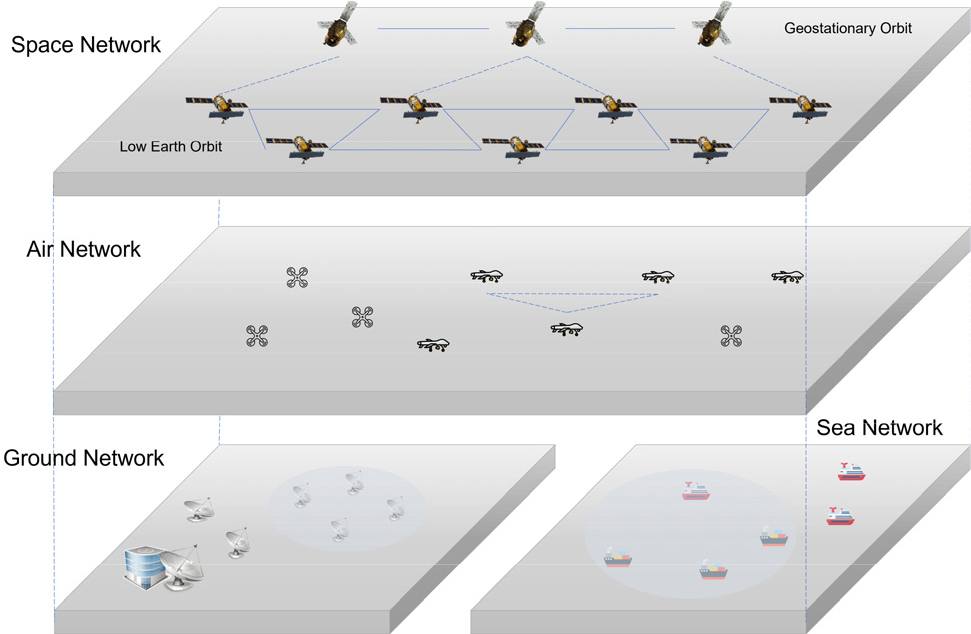
Securing space-ground communication links remains paramount. “Jamming,” recognized as a significant threat to space security, falls under the regulatory purview of the ITU and national radio legislation. Security countermeasures against malicious jamming threats include frequency hopping, spread spectrum, and multipath technologies. Fast orthogonal search, signal cross- correlation, and turbo codes have undergone extensive simulations and experimental validation as methodologies for mitigating GPS signal interference. Satellite ground stations utilizing GPS signals implement defensive measures against jamming through the deployment of GNSS firewalls [6].
5. EXAMPLES OF SPACE SECURITY IN MAJOR COUNTRIES
5.1. United States
The National Institute of Standards and Technology (NIST) has formulated comprehensive guidelines for space-related cybersecurity frameworks. NIST IR 8270 (2023.07) delineates the application, requirements, and controls within the NIST Cybersecurity Framework, serving as authoritative guidance for managing cybersecurity risks throughout the lifecycle of commercial satellite operations (Fig. 6).
5.2. Japan
Japan’s Space Industry Office within the Manufacturing Industry Bureau of the Ministry of Economy, Trade and Industry has promulgated the Cybersecurity Guidelines for Commercial Space Systems (23.3) with a subsequent revision released as version 2.0 (24.3). These guidelines function as essential references for space system operators establishing cybersecurity measures, while simultaneously serving as evaluative criteria enabling government and local authorities to assess compliance with cybersecurity requirements during space systems procurement.
5.3. Korea
Addressing physical and administrative security, Korea has implemented the Security Management Regulations for Space Development Projects through Administrative Regulations of the Ministry of Science and ICT (established 2014**)**. Subsequently, in 2020, the Space Development Promotion Working Committee ratified recommendations governing the development and operation of space vehicles with specific provisions for space debris mitigation.
6. ISSUES RELATED TO SPACE SECURITY
6.1. Development and Production Phase
Supply chain management encompassing diverse subsystems and software security constitutes a critical requirement. COTS management, incorporating security guidelines and hardening procedures for commercial products, proves essential.
6.2. Launch Phase
Security protocols throughout launch procedures and operations, coupled with launch vehicle cybersecurity, demand rigorous implementation.
6.3. Operational Phase
Space systems require comprehensive security measures. Although physical access becomes severely constrained once space objects achieve orbit, security threats persist unabated.
Organizations must maintain vigilance against attacks exploiting vulnerabilities in software and hardware architectures. Systems employing SDR and digital signal processing software for wireless capabilities face risks when insufficient verification of erroneous data packet transmissions precipitates buffer overflows, potentially creating denial of service conditions. Defensive measures must address threats involving satellite trajectory manipulation and unauthorized reproduction of stored information.
Data links demand robust security protocols. Jamming involves emitting high-power RF signals targeting ground stations or satellites. Eavesdropping encompasses unauthorized data acquisition through communication channel interception. Hijacking represents the illicit acquisition of satellite control for malicious repurposing. Spoofing involves the injection of falsified data masquerading as authentic transmissions.
Ground system security remains indispensable. Physical attacks encompass deliberate damage, service disruption, and unauthorized satellite control. Computer Network Exploitation (CNE) denotes sophisticated attacks on networked ground stations facilitating unauthorized infiltration of control systems through techniques including phishing. Cloud infrastructure vulnerabilities manifest when cloud services such as AWS experience DDOS attacks, thereby disrupting satellite- based real-time systems dependent on cloud-managed ground stations. Data corruption and modification scenarios arise when SW or HW errors generate corrupted commands transmitted to satellites, resulting in catastrophic operational losses. Supply chain attacks exploit vulnerabilities embedded within the supply chain, including compromised SW/tools/open source components.
Publicly disclosed vulnerabilities, particularly those affecting unpatched, outdated or legacy COTS systems, necessitate proactive updates and comprehensive network security measures.
6.4. Disposal Phase
Preventing cyber access to decommissioned satellites requires systematic protocols. Continuous monitoring for cyberattacks must persist until complete satellite destruction.
6.5. Security Strategy for Industry-Academia-Research Participation
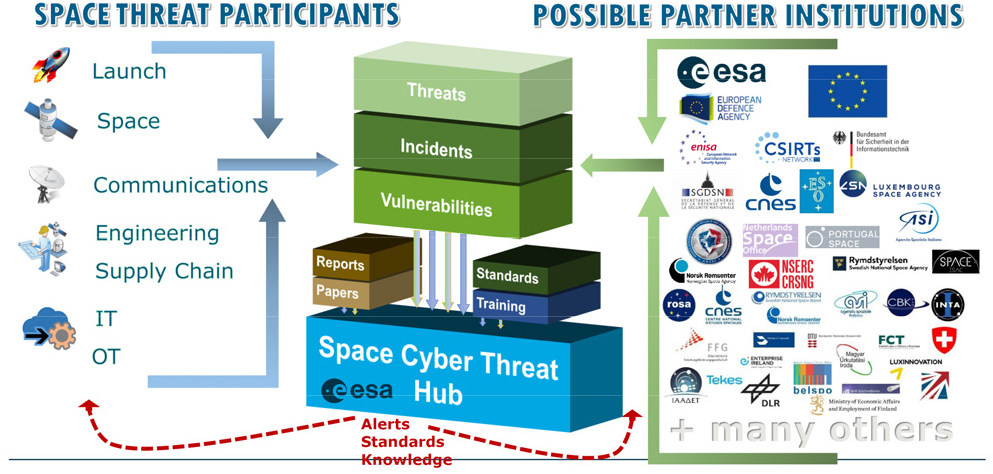
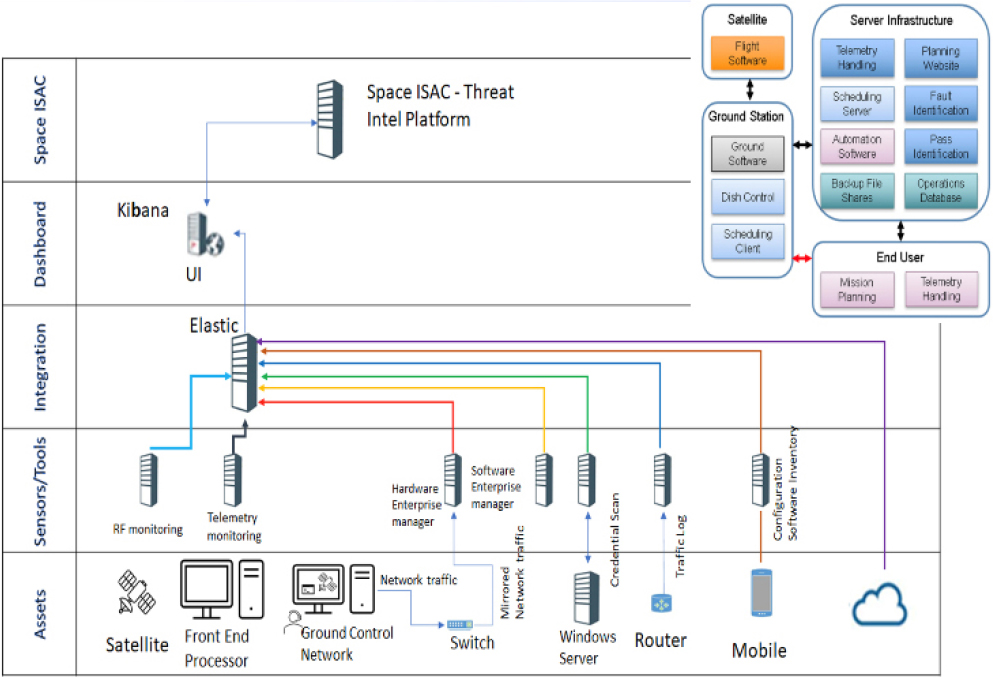
ESA exemplifies effective industry-academia-research cooperation through strategic partnerships with the Cyber Centre of Excellence and the Cyber Security Operations Center (Fig. 7).
6.6. Security Topics for Space Systems
The integration of emerging technologies such as AI, satellite phone service, and satellite imagery substantially expands the attack surface once threat actors penetrate space systems.
Adversaries increasingly favor cyberattacks over kinetic ASAT operations that generate space debris. CubeSats frequently deploy without adequate cybersecurity considerations.
Hardware/software upgrades present formidable challenges for orbital space objects. Spacecraft endure extreme temperatures, radiation, and micro-meteoroid bombardment within the space environment, potentially degrading defensive capabilities.
The space ecosystem exhibits inherent complexity and uniqueness, characterized by extended, distributed supply chains incorporating commercial off-the-shelf products (COTS) that create expansive attack surfaces with heightened potential for errors and vulnerabilities, particularly during multiple systems integration.
The pervasive lack of public access to technical details, exemplified by technology developers’ reluctance to disclose specifications such as satellite firmware, compounds security challenges. Moreover, certain categories of cyberattacks demand enormous resources for planning and execution, while successful intrusion into space systems represents a coveted achievement within “hack-a-sat” communities.
Unlike kinetic or physical attacks, cyberattacks operate outside clear legal frameworks. Cyber operations offer low-cost, yet economically and politically potent tactical options with minimal environmental impact. Numerous critical services depend fundamentally on space systems infrastructure [7].
7. SPACE SECURITY GUIDELINES (DRAFT)
The author proposes comprehensive security guidelines aligned with the complete life cycle of space systems (Table 1) [8].
TABLE 1.
Space System Lifecycle Security Guidelines
8. SPACE SECURITY STRATEGY
8.1. Cyber Threats and Countermeasures in Space
Satellite hijacking through sophisticated intrusions into control systems of low-orbit satellite networks, subsequently weaponizing compromised assets against other satellites, represents an escalating threat vector. On March 26, 2024, the National Satellite Operation Center, bearing responsibility for controlling multipurpose satellites including Arirang 3A and managing the acquisition and processing of satellite imagery, suffered a significant cyber breach. Historical precedents include compromises of the Landsat 7 satellite and the Terra AM-1 satellite in 2007 and 2008 respectively, alongside the Viasat satellite breach in 2022.
System-wide disruptions affecting satellite-dependent infrastructure such as communication, navigation, and earth observation continue to proliferate. During the 2022 Ukrainian conflict, Russian military forces executed a cyberattack against the Starlink satellite network, resulting in the operational compromise of multiple satellites. In 2017, a coordinated GPS spoofing attack in the Black Sea affected the navigation systems of no fewer than 130 vessels, erroneously positioning the ships at an inland airport [9].
8.2. Enhancing Security for Proprietary Satellite Assets
NASA’s Dynamic Space Operation (DSO) project enables orbital maneuverability for satellites within shared orbital regimes, addressing inherent vulnerabilities to attack. Satellite on-orbit refueling technology undergoes continuous development to replenish propellant consumed during defensive orbital maneuvers [10].
The Quantum Key Distribution (QKD) project advances space security through quantum technologies, with EAGLE-1 under development by SES to validate QKD functionality between satellites and ground stations in low Earth orbit, thereby securing quantum internet infrastructure, quantum computers, and sensitive information assets across Europe [11].
8.3. Strengthening Space Control
Cyberattacks demonstrate dramatically lower operational costs compared to defending space systems. Current strategic doctrine necessitates offensive capabilities to effectively counter adversarial attacks and compensate for initial losses resulting from surprise engagements [12].
Offensive cyber operations and satellite interdiction capabilities against hostile satellites represent essential deterrent measures. France’s FLAMHE project features deployment of high- power laser systems on geostationary platforms, scheduled for operational status by 2030, enabling neutralization of hostile satellites without generating persistent space debris [13].
9. CONCLUSION
Drawing upon exemplary frameworks such as ESA (Space-Shield) and Aerospace Corporation (SPARTA), the development of a comprehensive Korean space system security management system emerges as an urgent national imperative (Fig. 8, Fig. 9).
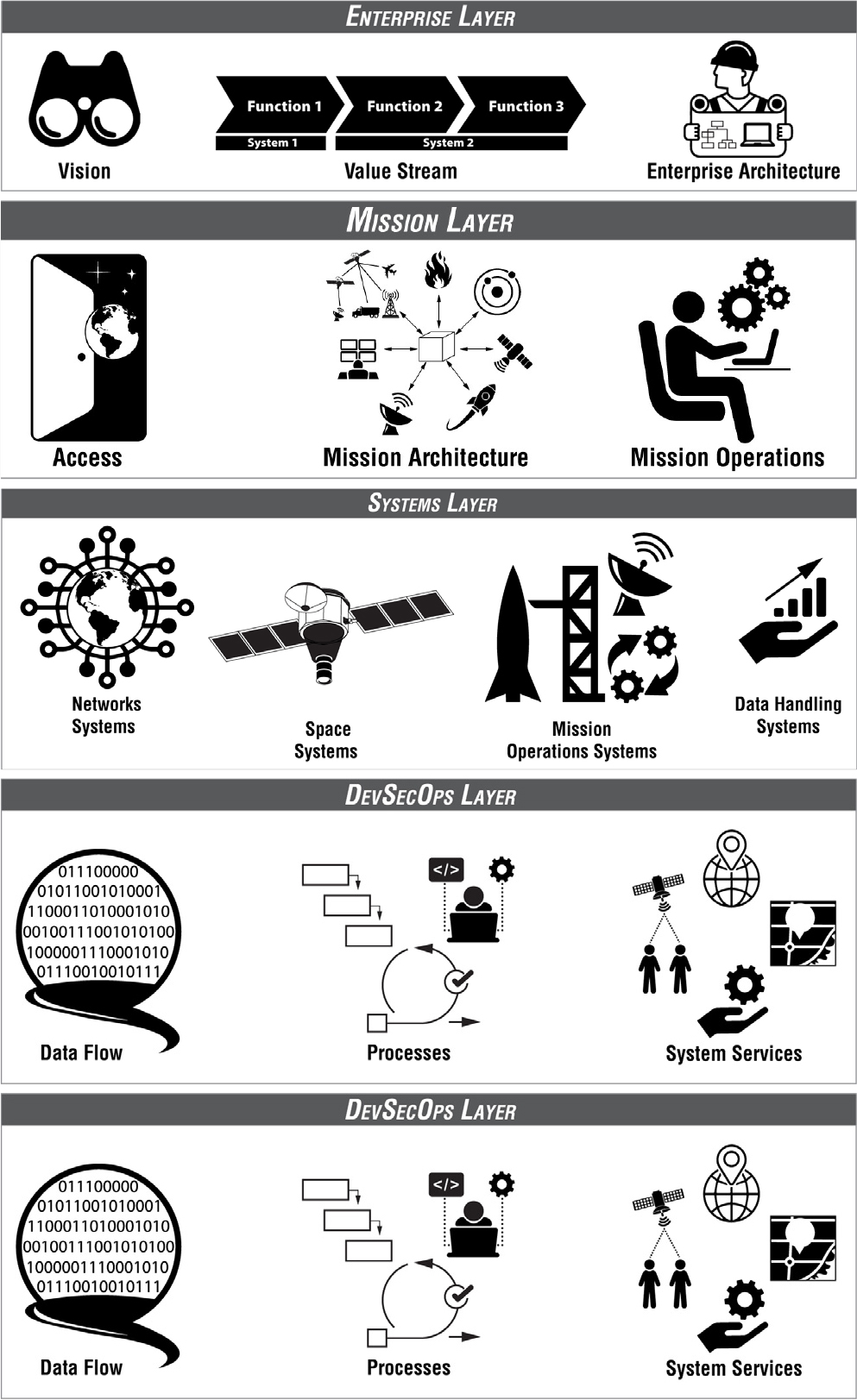
Within the conceptual framework of space security, the space system comprises interconnected ground segment, space segment, link segment, and user segment components. Through systematic examination of the complete life cycle of space objects, this research has advanced both policy and technological alternatives essential for establishing robust space security operation systems.