

-
Research Article
- Research on the establishment of space environment test facility and security management strategy for large satellite system
- Jong-Min Im, Seong-Bin Lim, Hee-Kwang Eun, Ji-Seok Kim, Min-Jun Kim
- Satellites of various geometries and weights have been developed in the recent years, from very small satellites constellations to geostationary satellites. For …
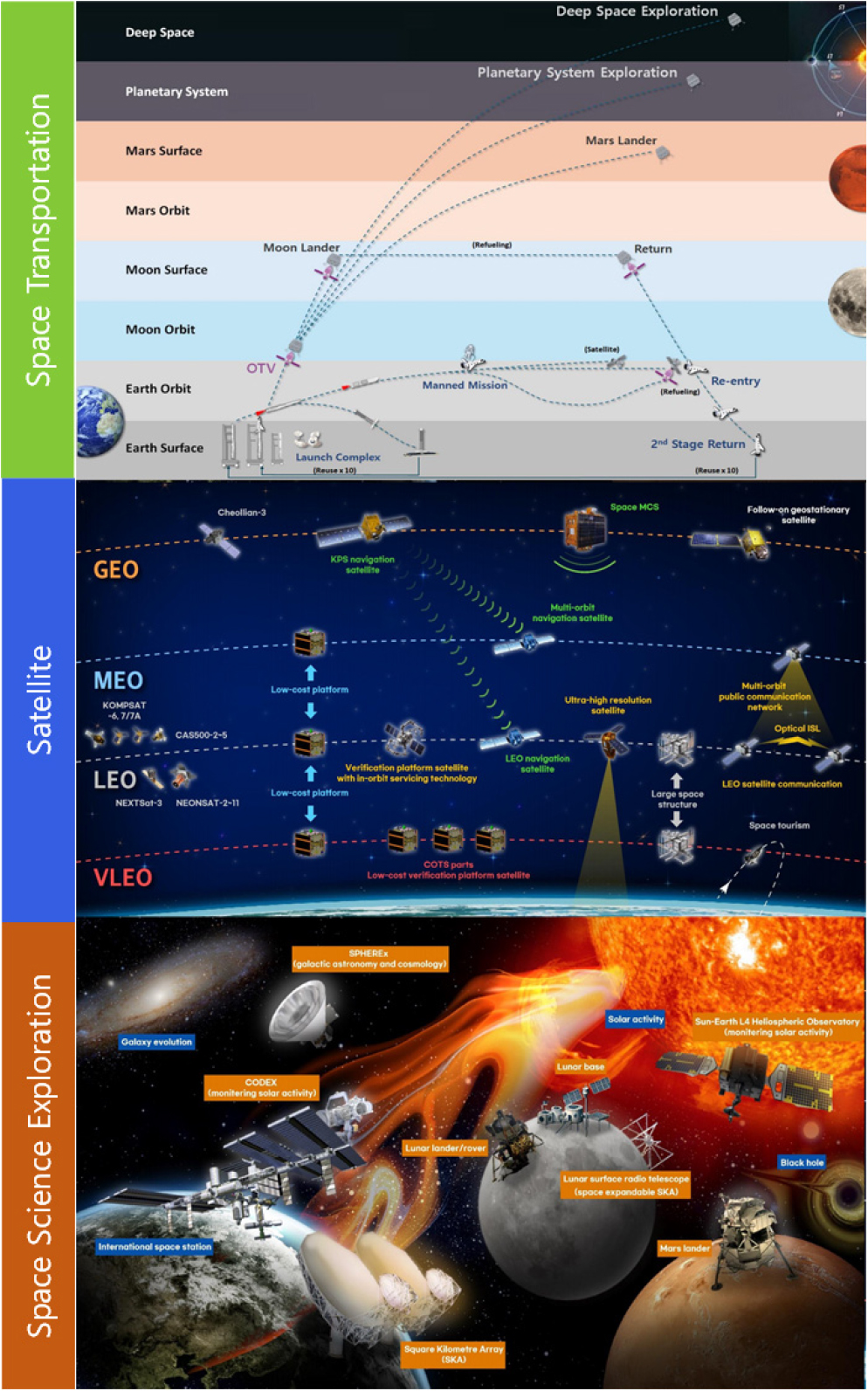
- Satellites of various geometries and weights have been developed in the recent years, from very small satellites constellations to geostationary satellites. For space systems such as satellites and launch vehicles, it is essential to verify various space environments on the ground. To this end, the Korea Aerospace Research Institute has been operating a space environment test facility since 1996, and recently, with the expansion of the space industry, a number of space environment test facilities are being built in Korea. In addition, for the verification of high-performance large satellites and large systems that are planned to be developed in the future, preemptive construction of space environment test facilities that can accommodate them is an essential factor. In the case of large space environment test facilities, the construction, operation, and maintenance of large facilities are costly, so private joint utilization is essential to secure economic efficiency and effectiveness. Many large space environment test facilities in the U.S., Europe, and Japan are already providing test services through joint utilization by receiving requests from various users. In this study, we identified additional test facilities required to conduct space environmental tests for large systems to be developed in the future and examined how to build them. In addition, a study was conducted on the layout and security management strategy of test facilities for public-private joint utilization. - COLLAPSE
-
Research Article
- Radio frequency attacks on open-source ground station
- Young Eun Kwon, Youngjoon Kim, Ji Hyuk Jung, Hyeongjun Choi, Ji Won Yoon
- The space industry has experienced exponential growth, driven by private sector initiatives and the democratization of space technology. This has resulted in …
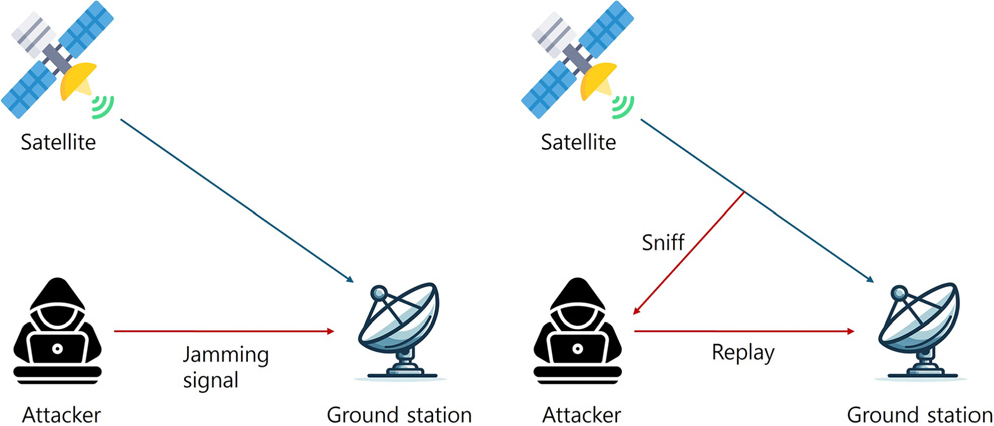
- The space industry has experienced exponential growth, driven by private sector initiatives and the democratization of space technology. This has resulted in an increase in satellite launches and the adoption of open-source technologies for ground stations. Projects like SatNOGS and TinyGS have facilitated the accessibility of satellite communication for individuals and institutions, reducing the technical barriers to entry. However, this open-source approach introduces considerable cybersecurity vulnerabilities, particularly in the RF communication layer, which has not been sufficiently investigated in existing research. In this paper, we evaluate the security of open-source ground stations through the design and testing of realistic attack scenarios, with a particular focus on jamming and replay attacks. We generated interference signals with the purpose of disrupting satellite communication. Additionally, satellite signals were captured and replayed in order to simulate unauthorized access or communication disruption. Experiments on the TinyGS platform demonstrated that these attacks can be executed with minimal effort. It is therefore evident that security strategies need to be developed and implemented. - COLLAPSE
-
Research Article

- Contractual considerations for space asset joint-development
- Il Seok Oh
- The joint development of space assets is characterized as a long-term, high-risk project involving cutting-edge technology and large amounts of capital. It …
- The joint development of space assets is characterized as a long-term, high-risk project involving cutting-edge technology and large amounts of capital. It is also a business that reflects the diverse interests of various countries, governments, and private specialty companies involved in the joint development, as well as the companies that are under contract with them. In addition, it is an international project that requires the consideration of both national and international laws when examining legal considerations. Therefore, joint development of space assets is necessary to secure autonomy in space in the era of US-China competition, resolve the imbalance in the supply and demand of space assets, reduce costs, accumulate cutting-edge science and technology, and to take the lead in peaceful development of space. In order to succeed in the joint development of space assets, it is necessary to establish a legal way to hedge various risks related to joint development. To this end, this paper focuses on the formation of contractual relationships for the execution of joint development and the design of contracts accordingly. The paper also analyzes contract cases related to joint development of space assets. Based on this, we first presented general considerations for joint development contracts, including financing methods and development governance structures, licenses, permits, or approvals, export controls, attribution of intellectual property rights, risk and liability sharing and warranty periods, dispute resolution procedures, government risk protection, insurance, and confidentiality. In addition, the legal considerations for the design and construction, launch, operation, and disposal of space assets along their life cycle are discussed. By considering various legal issues related to joint development of space assets, the risks of joint development should be distributed. Based on this, it is considered necessary to build trust and cooperation among the joint development participants to ensure that the joint development leads to sustainable space development. - COLLAPSE
-
Research Article

- Analysis of operational trends and essential modeling factors for enhancing the utilization of low earth orbit satellites
- Du-hui Yun, Seok Teak Yun
- In this paper, we analyze the latest research trends to maximize the operational efficiency of low Earth orbit (LEO) satellites and identify …
- In this paper, we analyze the latest research trends to maximize the operational efficiency of low Earth orbit (LEO) satellites and identify the essential technologies required for this purpose. Traditional satellite operation methods face challenges due to the limited communication environment with ground stations, making real-time status monitoring difficult and leading to conservative mission operations. This approach not only reduces resource utilization but also increases operational costs and introduces uncertainties in mission execution. Moreover, the lack of predictive models that account for the long-term degradation and aging of satellite systems hinders the development of reliable simulators and mission optimization. Recent studies have highlighted the potential of artificial intelligence (AI) and machine learning (ML)-based predictive models to address these challenges. AI-based models enable precise state diagnostics even when satellites are in non-contact periods, outperforming traditional ground station-dependent methods. As satellite operational environments become increasingly complex and mission requirements diversify, the ability to analyze vast telemetry data in real time and detect anomalies at an early stage has become crucial. Reflecting this need, AI and ML technologies have been widely applied in various domains, including power system anomaly detection, battery performance degradation prediction, and attitude control optimization, demonstrating their effectiveness. This paper examines how AI-based technologies can enhance the efficiency of LEO satellite operations and presents key modeling techniques for effectively implementing such predictive models. Specifically, we discuss the necessity of modeling power conversion systems, energy storage devices, and attitude prediction systems while evaluating the contributions of AI-based predictive models to improving satellite operational performance. - COLLAPSE
-
Research Article
- Global trends in commercial ground station technologies and space security strategies
- Myungjun Kim, Sunghyuck Lee, Jeongho Han, Junbeom Bang, Yongha Kim, Hojong Lee
- With the rapid advancement of the New Space era, global competition in space technology development is intensifying. A prominent example is SpaceX's …
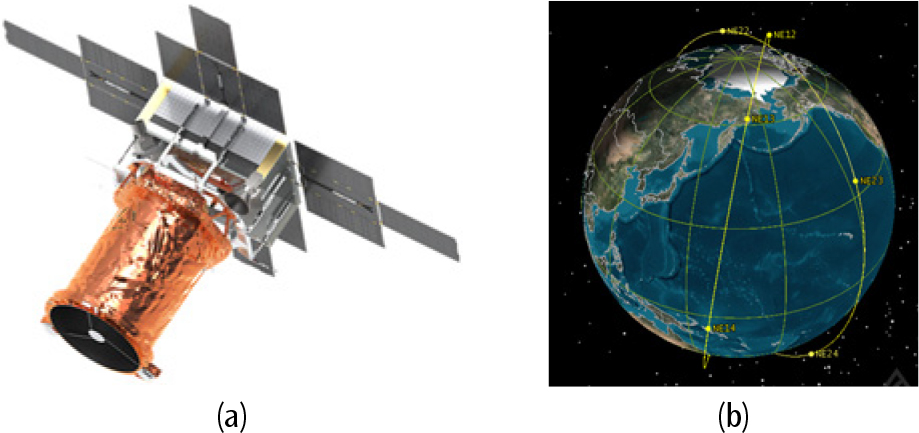
- With the rapid advancement of the New Space era, global competition in space technology development is intensifying. A prominent example is SpaceX's Starlink project in the United States, which aims to deploy approximately 40,000 low-Earth orbit (LEO) satellites by 2030. In South Korea, following the successful launch of the nanosatellite constellation NeonSat-1, plans are in place to launch and operate a total of 11 satellites by 2027. The efficient operation of such nanosatellite constellations and multi-mission satellite systems necessitates the use of either dedicated national ground stations or commercial ground stations that ensure space security. This study examines the operational frameworks and infrastructure of ground stations in leading space nations, including the United States, Europe, and Japan. A comparative analysis is conducted on the locations, infrastructure, and operational strategies of both domestic and international ground stations. Additionally, the study explores technological advancements in commercial ground station service providers such as KSAT, SSC, and CONTEC, assessing their potential integration into South Korea’s satellite operation strategies. Furthermore, this research examines key space security considerations for satellite and ground station operations, addressing emerging threats and technological advancements in the space domain. Based on these findings, security measures are proposed to enhance the resilience, reliability, and cybersecurity of satellite-ground station networks, ensuring robust protection against evolving space security challenges. - COLLAPSE
-
Research Article

- Recent trends in AI technology applications and related policies in the space security industry
- Hoonhee Lee, Dongwoo Shin, Seongin Hong, Joon-Min Choi, Gwanghyeok Ju
- The rapid growth of the space industry and the increasing number of space objects have highlighted the importance of space activities and …
- The rapid growth of the space industry and the increasing number of space objects have highlighted the importance of space activities and asset protection, expanding the scope of national security. In particular, the demand for space technology and informational resources to address conflicts and threats near Earth’s orbit is on the rise. Amid these changes, the advent of the NewSpace era, combined with generative artificial intelligence (AI) technologies, is driving the expansion of private space activities and fostering new technological advancements. This study analyzes trends in AI technologies within the space industry by defining and categorizing AI technologies specifically designed for space applications. It explores security threats and opportunities arising from these technologies and evaluates South Korea’s technological achievements by comparing its space AI capabilities to global standards. The study introduces case studies of AI applications across various industrial sectors and examines the current limitations of AI technologies in South Korea’s space industry. Furthermore, it proposes strategies for leveraging AI to enhance space security. By examining successful cases of utilizing satellite information through advancements in big data-based AI technologies and analyzing the AI policies of major space-leading nations, the study provides policy recommendations to promote a sustainable development of South Korea’s space security technologies and reinforce national security. - COLLAPSE

 JOURNAL OF SPACE SECURITY





 Korean Academy of Space Security
한국우주안보학회
#909 Instopia,120, Eonju-ro, Gangnam-gu, Seoul, Republic of Korea
Tel: 82-2-2039-1670 / E-mail: kass@kass.ne.kr Copyright© Korean Academy of Space Security. Powered by APUB
Tel: 82-2-2039-1670 / E-mail: kass@kass.ne.kr Copyright© Korean Academy of Space Security. Powered by APUB